
 Olive trees Pruning
Pruning olive trees
An olive grows slowly and wants very little from your secateurs. The skill is in the timing, and in knowing when to stop.
In short
Prune an olive tree lightly in late spring or early summer, the RHS says. Remove dead, diseased or dying branches back to a sideshoot and thin the crown to let light in. Avoid hard pruning, which brings vigorous upright shoots, and do not prune after August.

The short answer: a light prune in late spring or early summer
Prune an olive tree in late spring or early summer, and only lightly. That is the advice of the RHS growing guide for olives. It says olives grow slowly, so they do not need much pruning.
Three rules from the same guide frame the job:
- The window. Late spring or early summer. - The deadline. Do not prune after August, because new growth will not harden before the frosts. - The limit. Avoid hard pruning. It produces vigorous, upright shoots, called water shoots, which then need thinning out.
The RHS plant entry for *Olea europaea* agrees on how little is needed. It places the olive in pruning group 1, with a single note for trees grown under glass: prune in spring to restrict their size.
So most years the job takes a few minutes. You remove what is dead or damaged, take out anything that spoils the shape, and let some light into the middle of the tree.
Olive trees: what to do and when
Under cover and outdoors, for UK conditions. The weather differs from year to year and from north to south, so check your local conditions too.
Why late spring, and why not after August
An olive is an evergreen from the Mediterranean region, the RHS says, and timing is all about frost.
Late spring. The RHS guide to pruning evergreen shrubs gives the general reason. Most evergreens are pruned just before growth starts in mid-spring, after any risk of frost has passed. At that time new shoots escape frost damage, and the pruning scars are soon hidden by new growth. The olive guide sets the window a little later still, in late spring or early summer.
Not after August. The RHS says not to prune after August, because the new growth will not harden before the frosts. Our reading: pruning sets off new shoots, and shoots that start in late summer are still soft when the cold arrives.
How cold is too cold? The RHS growing guide says many olives are hardy through most of the UK and tolerate -5 to -10 °C. Severe frost, which it defines as below -5 °C, can still damage leaves and branches. The plant entry gives the olive the hardiness rating H4, hardy through most of the UK.
Our reading: if you prune too late, you are not only risking this year's soft shoots. You are also leaving fresh wounds and young growth exposed to the very temperatures the RHS warns about.
How to prune an established olive
The RHS method is short. Work through it in this order.
1. Dead, diseased or dying branches. Cut them back to a sideshoot. 2. The shape. Remove any branches that spoil it. 3. The light. Thin some branches so that light can reach the centre of the tree. 4. The trunk. If you want a clear stem, remove shoots growing near the base or along the trunk.
Cut to a sideshoot, not to nothing. The RHS growing guide asks for every cut on a dead or dying branch to go back to a sideshoot. Our reading: a stub left in mid-air has nothing to feed it and is likely to die back.
Keep it light. The guide repeats that olives need little pruning. If you cut more than you need, the tree answers with water shoots, and you have more pruning to do next year.
Why light pruning keeps the flowers. University of California researchers write that olives are borne on one-year-old shoots. Our reading: the shoots a tree grows this year carry next year's flowers, so heavy cutting removes them. In the UK that matters for the scent more than for fruit, as the next section explains.
Water shoots: the price of hard pruning
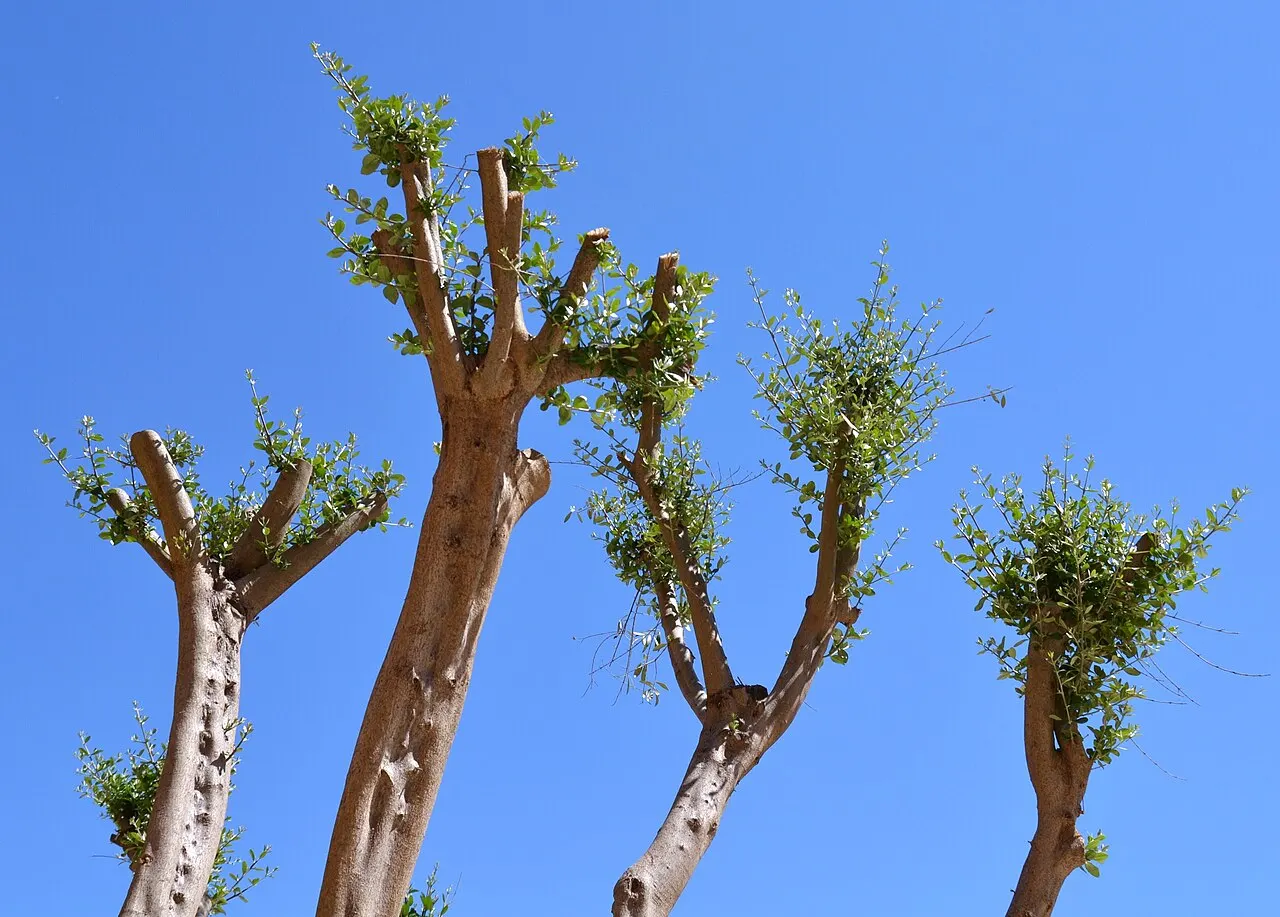

The RHS warns that hard pruning leads to vigorous, upright water shoots, which then need thinning out.
What this means in practice:
- One big cut is not a shortcut. You save a little time this year and gain a thicket of straight, upright stems next year. - Thin them early. The RHS asks for water shoots to be thinned. Our reading: remove them while they are young and soft, when a cut is small. - Keep the shape you want. Thinning water shoots is the same job as thinning any crowded branch: keep the ones that fill a gap and remove the rest.
The RHS growing guide gives no method for reshaping a large, overgrown olive. Its message is steady: olives need little pruning, and hard pruning causes problems. Our reading: if a tree has grown too big for its spot, reduce it a little each year within the late-spring window rather than all at once.
Olives in pots
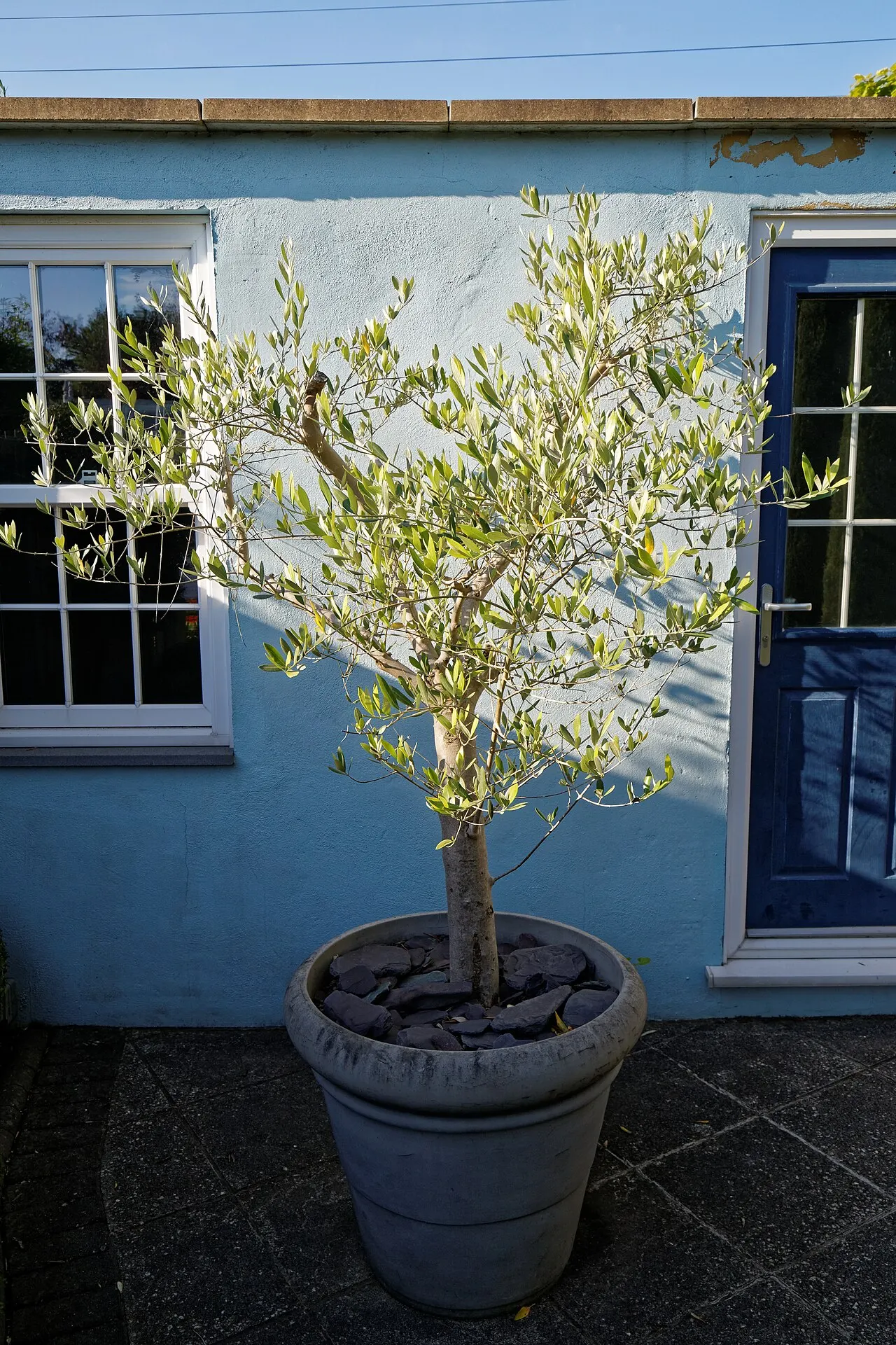
Most olives in British gardens grow in containers. The RHS gives them a few extra rules.
Pinch to branch. When plants in containers reach about 1.5 m, pinch out the tips to encourage branching.
Under glass. The RHS plant entry says olives grown under glass can be pruned in spring to restrict their size.
The pot itself. The RHS asks for a thick, frost-proof container at least 30–35 cm wide and deep, with plenty of drainage holes. It suggests a peat-free, soil-based compost such as John Innes No. 3, with about 20% horticultural grit by volume. Each spring it replaces the top layer: scrape away about 5 cm of compost and add fresh.
Water. Water container trees regularly from April to late September. In winter keep the compost barely moist and raise the pot on pot feet or bricks.
Winter. Move the pot under cover, or put it somewhere sheltered and wrap it when severe frost is forecast.
Our reading: a potted olive with dry roots in summer or wet roots in winter will drop leaves, and no pruning will fix that. Get the pot right first.
After a hard winter: frost damage
Severe frost, below -5 °C in the RHS definition, can damage leaves and branches.
Protect first. In very cold winters the RHS wraps a couple of layers of biodegradable fleece or hessian around the canopy. It removes the wrapping in milder weather and puts it back when severe frost is forecast.
Then wait. The RHS prunes out dead stems after frost damage in late spring, cutting back to new shoots. Our reading: in March it is hard to tell a dead twig from a dormant one. By late spring the living shoots have started to grow and show you exactly where to cut.
Leaf drop is not always frost. The RHS notes that olives shed some leaves in spring as a normal process. Leaf loss can also come from the compost being too dry, especially in containers.
Will pruning give me olives?
Probably not, and that is fine. The RHS says olives rarely fruit in the UK. Fruit occasionally forms in hot summers in some parts of the UK, and even then it needs special preparation to make it edible. So, the RHS says, olives are best chosen for their shape or foliage.
They do flower. The RHS describes fragrant sprays of small, creamy-white flowers in summer. The plant entry adds that the flowers are very small and white, in clusters up to 5 cm long.
Our reading: prune for shape and health, not for a crop. A light prune that keeps last year's shoots, as described above, also keeps the summer flowers.
The silvery look that makes olives so popular comes from small white hairs on the leaves, the RHS says. The plant entry describes the leaves as leathery and silvery beneath, up to 7.5 cm long.
Healthy tools, healthy tree: problems to know
The RHS lists a short set of problems for olives. Look for them while you prune.
- Scale insects. Named in both the growing guide and the plant entry. - Olive scab. A disease named in both. - Honey fungus. The plant entry says olives may be susceptible, rarely. - *Xylella fastidiosa*. The RHS says olives are a high-risk host for this disease.
Our reading: cut out diseased wood first, as the RHS method asks, and clean your blades between trees. For plant protection, use only products authorised for use in the UK and follow the label.
How big will it get? The RHS plant entry gives an ultimate height of 4–8 m and a spread of 1.5–2.5 m, reached in 20–50 years. Its description of a rugged, much-branched, slow-growing tree gives a slightly different figure, eventually 4.5–9 m. Either way, it takes decades. Our reading: in a pot it stays far smaller.
Pruning other evergreens this year? See pruning lavender, and for fruit trees with a summer calendar, when to prune plum trees.
Olive tree pruning at a glance
| Question | Answer |
|---|---|
| When | Late spring or early summer |
| Latest | Not after August: new growth will not harden before the frosts |
| How much | Lightly: olives grow slowly and need little pruning |
| What to remove | Dead, diseased or dying branches, back to a sideshoot. Branches that spoil the shape. Some branches to let light into the centre |
| Clear stem | Remove shoots near the base and along the trunk |
| Pot-grown trees | Pinch out the tips at about 1.5 m to encourage branching |
| Under glass | Prune to restrict size in spring |
| Frost damage | Cut dead stems back to new shoots in late spring |
| Avoid | Hard pruning: it brings vigorous upright water shoots |
How to do it
- Wait for late spring, when new shoots show you what the winter has killed.
- Cut dead, diseased or dying branches back to a healthy sideshoot.
- Remove any branch that spoils the shape of the crown.
- Thin a few branches so light reaches the centre of the tree.
- If you want a clear stem, rub off or cut shoots growing from the base and along the trunk.
- Stop there. Do not cut hard, and put the secateurs away by the end of August.
Common questions
When is the best time to prune an olive tree in the UK?
In late spring or early summer, the RHS says. Do not prune after August, because new growth will not harden before the frosts.
Can I prune an olive tree in autumn or winter?
The RHS sets August as the last month. Autumn cuts bring soft new shoots into the frost. Frost-damaged stems are left until late spring and then cut back to new shoots.
How much can I cut off an olive tree?
Not much. The RHS says olives grow slowly and need little pruning. It warns that hard pruning brings vigorous, upright water shoots that then need thinning.
How do I keep an olive tree small?
For a tree in a pot, the RHS pinches out the tips at about 1.5 m to make it branch. Its plant entry says olives under glass can be pruned in spring to restrict their size.
How do I get a clear trunk on my olive tree?
Remove the shoots that grow near the base and along the trunk, the RHS says.
Why is my olive tree dropping leaves?
The RHS says some leaf shedding in spring is normal. Leaf loss can also mean the compost is too dry, especially in containers, or follow severe frost below -5 °C.
Will my olive tree fruit if I prune it?
Olives rarely fruit in the UK, the RHS says, and only occasionally, in hot summers. Pruning is for shape and health.
Sources
We wrote this page using the sources below.
- How to grow olives, Royal Horticultural Society (RHS)
- Olea europaea (F), Royal Horticultural Society (RHS)
- Shrubs: pruning evergreens, Royal Horticultural Society (RHS)
- Olive tree phenology, University of California Agriculture and Natural Resources (UC ANR)