
 Pears Pruning
Pruning pear trees
A little pruning every winter keeps a pear tree open, low enough to pick and full of fruiting wood, and a light hand works better than a heavy one.
In short
Prune free-standing pear trees every winter while they are dormant, between November and early March, the RHS says. Take out dead, diseased, crossing and inward-growing wood, and remove about 10–20% of the canopy. Trained pears such as cordons and espaliers are pruned in summer, cordons from late July.

Pears: what to do and when
Under cover and outdoors, for UK conditions. The weather differs from year to year and from north to south, so check your local conditions too.
Do pear trees need pruning?
Yes, and every year. The RHS growing guide for pears says free-standing trees should be pruned in winter to keep them healthy, in good shape and fruiting well, and that newly planted trees should be pruned straight away.
The aim, in the words of the RHS winter pruning guide, is a tree that stays productive and manageable in size, with an open, goblet-shaped crown and evenly spaced main branches. Light and air moving through the canopy mean better fruit and fewer pests and diseases.
Gardeners' World describes what happens otherwise. Unpruned trees can become straggly and less productive.
The RHS covers apples and pears in the same pruning guides, and the method is shared. If you grow both, see pruning apple trees. This page follows the same method and adds what the sources say about pears in particular.
How pears differ from apples
For pruning, very little. The RHS writes its winter, new-tree, cordon and renovation guides for apples and pears together, and gives one method for both.
The differences the RHS does name lie elsewhere.
Blossom. Pears flower significantly earlier than apples, so their blossom is at greater risk from late frosts. That matters when you choose a spot for the tree, though not how you prune it.
Roots. Pear trees are not grown on their own roots, the RHS says, because they would reach 6 m or more. They are grafted onto a rootstock, and the rootstock determines the growth rate and size of the tree. There is more on that under renovation, below.
Summer timing. Trained pears are summer-pruned earlier than apples. Cordons are cut from late July, where apples wait until mid- to late August.
Fruiting wood. The RHS leaves young side-shoots unpruned so that they can form fruit buds in their second year, and it no longer recommends routinely shortening all the young growth on spur-bearing trees. Old spurs are thinned only where they are crowded.
When to prune pear trees
Free-standing trees: winter. The RHS says to prune while the tree is dormant, after leaf fall and before the buds swell and open. Its window is November to early March.
Gardeners' World says midwinter for standard pears. Both sources agree on the principle. The tree must be dormant.
There is a practical reason too. Gardeners' World points out that on a leafless tree you can see its form and where the fruit buds sit.
Trained trees: summer. The RHS says trained pears should be pruned in late summer, to restrict growth and improve fruiting. Gardeners' World says the same of fans and espaliers. For cordons the RHS gives a start date: pears from late July, earlier than apples, which wait until mid- to late August.
Why two seasons? Gardeners' World explains it well. Winter pruning concentrates the spring flow of sap into fewer buds, so it produces strong growth. Summer pruning removes young, nitrogen-rich growth, which limits vigour and promotes flowers and fruit.
How much to take off
This is the question that worries most people, and the RHS gives two figures.
- Routine winter pruning: about 10–20% of the canopy. - Renovating a neglected tree: no more than 25% of the canopy in any one year.
The first is what a tree in good order needs each winter. The second is an upper limit for an overgrown tree.
What happens if you overdo it. The RHS warns that pruning too hard triggers a mass of upright, vigorous water shoots. Gardeners' World describes them as vertical shoots that do not flower or fruit, and says managing them takes several years.
Winter pruning an established tree, step by step
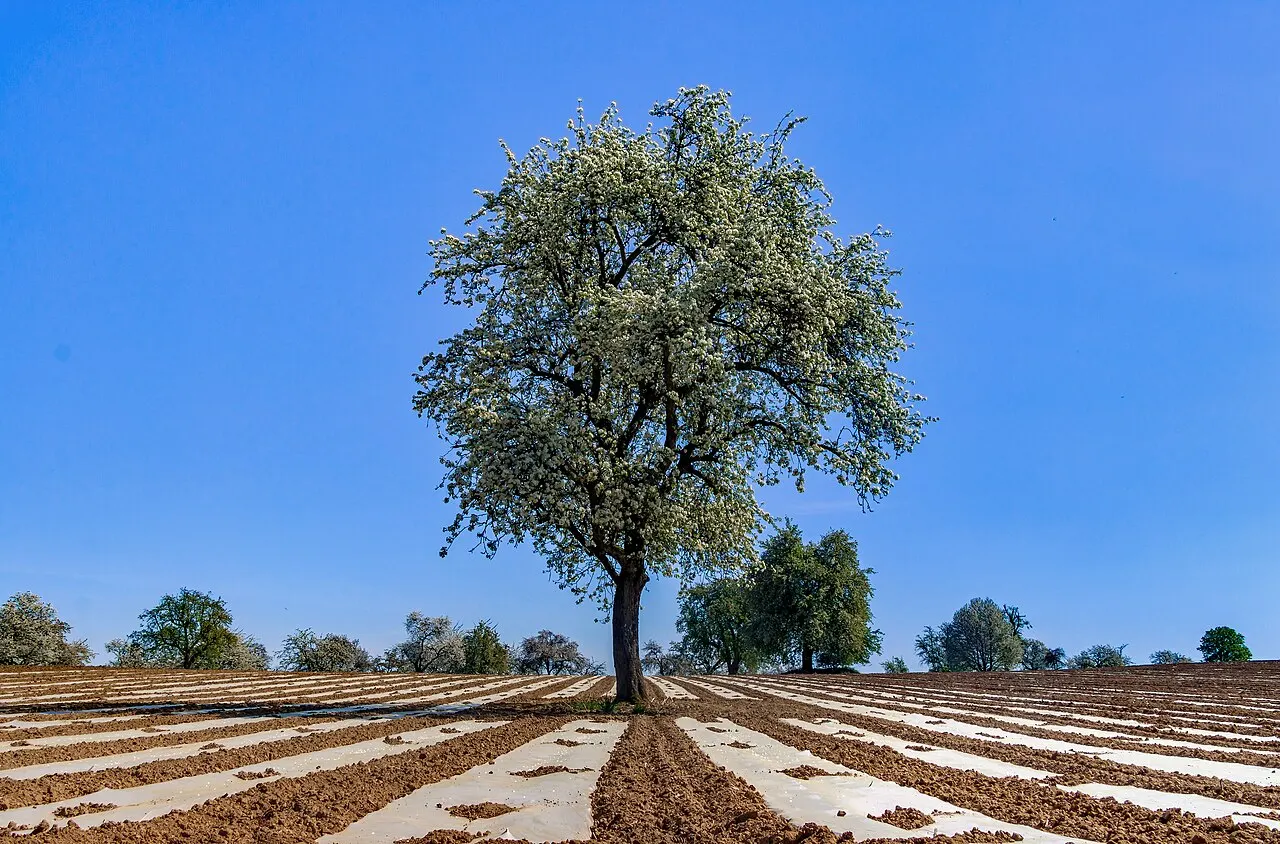

The RHS method applies to bush trees, which have a crown on a short trunk, and to standards and half-standards. It usually starts about four or five years after planting.
Tools. Sharp secateurs, loppers and a pruning saw. The RHS also lists a sturdy ladder, eye protection and gloves.
1. Dead, diseased and damaged wood comes out first. 2. Crossing and rubbing shoots. Keep the better-placed one that faces outwards, unless it is badly damaged. 3. Strong shoots growing into the centre. Remove them. Weaker shoots up to 20 cm long can stay. 4. Low branches that grow downwards and get little light. Cut them back to an upward branch or to the trunk. 5. Main branches. Shorten the previous season's growth by a quarter to a third, cutting above an outward-facing bud. This encourages branching and fruiting spurs. 6. Young side-shoots. Leave them. They form fruit buds in their second year. Remove them only if they cross, or if they sit closer than 10–15 cm apart at the base. 7. Old spurs. On older trees, thin overcrowded spurs so that they are spaced 10–15 cm apart along the branch. 8. A tree that is too tall or crowded. Shorten branches by up to a third. Cut to a strong side-branch that faces outwards and upwards and is at least one-third the diameter of the branch you remove.
After pruning, the tree should have an open centre. An RHS illustration shows about five main branches.
One point where the sources differ. Gardeners' World cuts the previous season's sideshoots back to four to six buds. The RHS now takes a lighter line. It leaves young side-shoots unpruned so that they can form fruit buds, and it no longer advises routinely shortening all the young growth. We follow the RHS here.
Pruning a newly planted pear tree
The RHS guide for new apple and pear trees covers one- and two-year-old trees. The first cut is made straight after planting, while the tree is dormant, usually between November and early March. The aim is a bush tree with a clear trunk of 70–90 cm and an open, goblet-shaped crown.
A maiden with no side-shoots. Cut the stem just above a bud about 75 cm above the ground, leaving three or four healthy buds below.
Year 1 (a feathered maiden or two-year-old tree). Choose three or four strong, evenly spaced side-shoots with wide angles, the topmost about 75 cm up. The RHS pictures them as the ribs of a half-open umbrella. Cut the main stem back to just above the top one. Shorten the chosen side-shoots by one-half to two-thirds, above an outward-facing bud. Remove any side-shoots lower down.
Year 2. Select eight to ten well-spaced shoots as the permanent framework. Shorten them by one-third to one-half. Take out any strong upright shoot in the centre.
Year 3. Cut back the previous year's growth on the main branches by one-quarter. Leave the side-shoots alone, because they will form fruiting spurs.
From year 4, follow the winter method above.
Fruit on a young tree. In the first year the RHS removes any young fruit, so that the tree can establish. In the second year, one or two fruits may stay if the tree is growing well.
Still choosing a tree? Start with when to plant pear trees.
Cordons, espaliers and fans
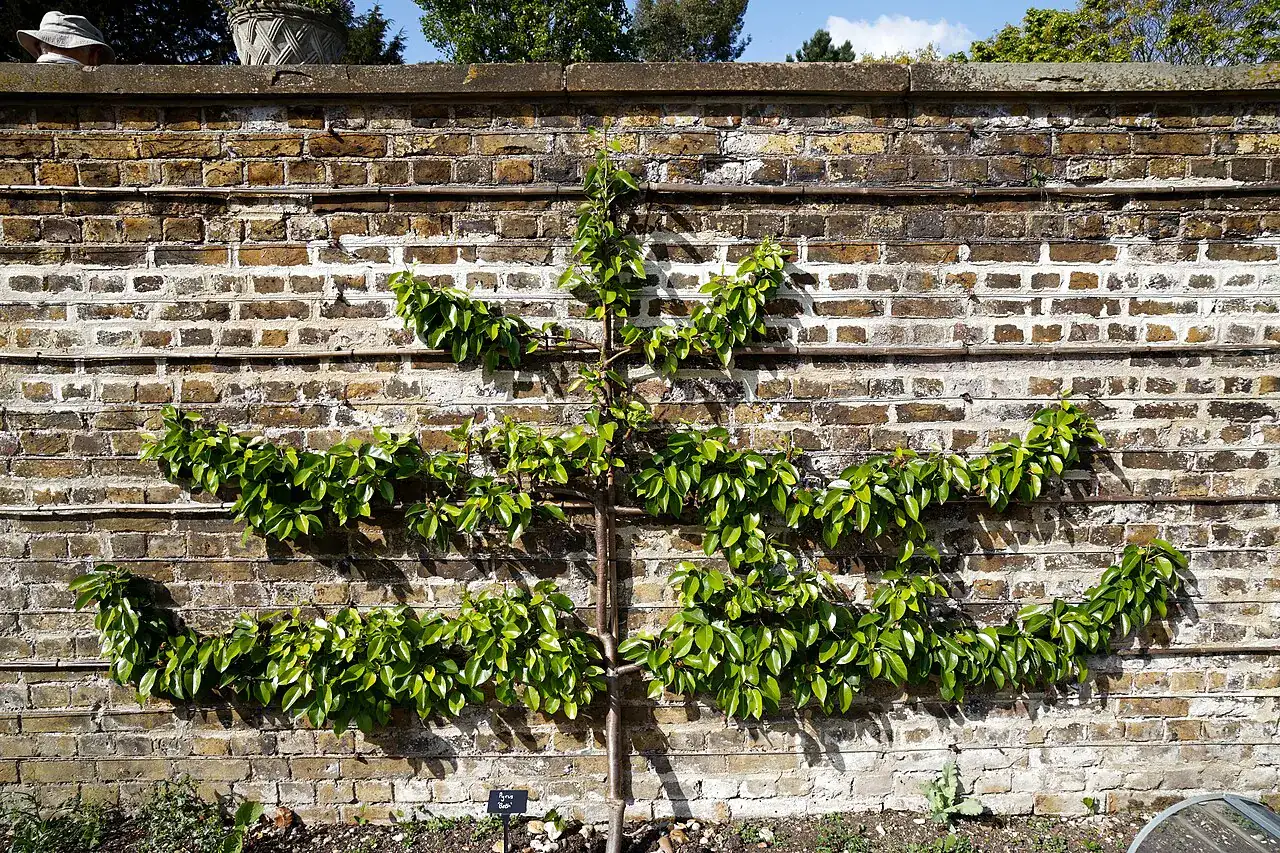

Pears take well to training. The RHS says a trained pear can take barely any ground space against a wall. A cordon is a single stem, usually at 45 degrees, with very short fruiting side branches. An espalier has a central trunk with tiers of horizontal branches. A fan has a short trunk with branches radiating from the top.
These forms are pruned in summer. The RHS method for an established cordon:
- Start once the lower third of the new shoots has turned woody. For pears that is from late July. - Find new shoots longer than 20 cm that grow from side-shoots or spurs. Cut each back to one leaf beyond the basal cluster. - Leave shoots shorter than 20 cm. They usually end in a fruit bud. - Check the ties while you are there. Loosen tight ones.
If the tree shoots again after summer pruning, the RHS says to delay pruning until September, when the terminal buds have formed and growth has stopped.
If you missed the summer prune, the RHS has a winter fix. Once the tree is dormant, cut last year's shoots from the main stem to 5–7.5 cm, above a bud, then go back to summer pruning.
In winter, thin the spur systems by removing older, unproductive sections. Take no more than one-third of the side-shoots in a year.
Renovating an old pear tree
An old, neglected pear can be brought back, the RHS says, but only if the trunk is healthy and the main branches are still growing and fruiting. Have a large tree checked by a qualified arborist first.
When. Between late autumn and late winter, when the tree is not in leaf. The RHS lists November to February.
How fast. Slowly. Remove no more than 25% of the canopy in a year and spread the work over two or three years. Taking too much at once produces water shoots that take years to control.
What to remove, in the RHS order: dead, broken and diseased branches. Low branches in deep shade. Larger branches growing into the centre. One of each crossing pair. Then shorten over-tall branches to a strong side branch lower down.
What to aim for. Main branches 50–60 cm apart, and no more than eight to ten of them.
What to avoid. Bare stumps, which encourage water shoots or dieback. Removing branches thicker than 20 cm unless you really have to. Cutting flush to the trunk: cut just outside the branch collar. And wound paint, which the RHS no longer recommends.
A reality check. The RHS says the size of a tree depends largely on its rootstock. Pears on Quince A reach 3–4.5 m. Those on the dwarfing Quince C reach 2.5–3 m. Pruning can improve an old tree, but it is unlikely to keep a big tree small.
Disease, and what to watch for as you prune
Pruning time is a good moment to look the tree over.
Diseased wood. The RHS begins every method on this page by cutting out dead and diseased wood.
Fireblight. Gardeners' World says to prune out infected material immediately, cutting back to healthy wood, and to wipe pruning tools with disinfectant between cuts.
Canker. The RHS describes sunken patches of dead bark on the branches. Its renovation guide calls canker a common problem in older trees and cuts out affected growth first.
Moss and lichen. The RHS says they are often a sign of poor growth, but not the cause of it.
Thin the fruit in summer. Pruning is one half of managing the crop. The RHS thins fruit on trained trees to one per cluster, 10–15 cm apart, and on free-standing trees to two per cluster where you can reach, if the tree still carries a heavy crop by mid-summer. Pears also shed fruitlets themselves in early summer, in what is called the June drop.
Pear pruning at a glance
| Tree | When | What to do |
|---|---|---|
| Established bush or standard | November to early March | Remove about 10–20% of the canopy; shorten last season's growth on main branches by a quarter to a third |
| Newly planted maiden, no side-shoots | After planting, while dormant | Cut the stem above a bud about 75 cm from the ground |
| Young tree, first three winters | November to early March | Build an open goblet of well-spaced branches |
| Cordon | From late July | New shoots over 20 cm long back to one leaf beyond the basal cluster |
| Fan and espalier | Summer | Summer pruning to restrict growth |
| Old, neglected tree | November to February | No more than 25% of the canopy a year, over two or three years |
| Over-vigorous tree | Mid-August to mid-September | Side-shoots longer than 30 cm shortened to 15 cm |
How to do it
- Wait until the leaves have fallen. Gather sharp secateurs, loppers and a pruning saw, plus gloves and eye protection.
- Remove dead, diseased and damaged wood first.
- Where two shoots cross or rub, take one out and keep the better-placed, outward-facing one.
- Remove strong shoots growing into the centre. Weaker ones up to 20 cm long can stay.
- Remove low branches that hang down and get little light.
- Shorten last season's growth on each main branch by a quarter to a third, cutting above an outward-facing bud.
- Leave young side-shoots alone unless they cross or crowd. Thin old, congested spurs to 10–15 cm apart.
- Stop when about 10–20% of the canopy has gone.
Common questions
When is the best time to prune a pear tree?
For a free-standing tree, while it is dormant: November to early March, the RHS says. Gardeners' World says midwinter. Trained cordons, fans and espaliers are pruned in summer, cordons from late July.
How much can I cut off a pear tree?
The RHS removes about 10–20% of the canopy in a routine winter prune and never more than 25% a year when renovating. Pruning too hard brings a flush of upright water shoots.
Can I prune a pear tree in summer?
Trained pears, yes: the RHS prunes cordons from late July. On an over-vigorous free-standing tree it also shortens side-shoots longer than 30 cm to 15 cm between mid-August and mid-September, in addition to winter pruning.
How do I stop a pear tree growing too tall?
Shorten tall branches by up to a third, to a strong outward-facing side-branch, the RHS says. Avoid hard cuts, which cause upright water shoots. Size depends largely on the rootstock, so an old tree on a vigorous one cannot be kept small.
Do I prune a newly planted pear tree?
Yes, straight after planting while it is dormant, the RHS says. A maiden with no side-shoots is cut above a bud about 75 cm from the ground. On a feathered tree, three or four side-shoots are kept and shortened by one-half to two-thirds.
What are water shoots on a pear tree?
Vigorous, vertical shoots that appear after hard pruning. Gardeners' World says they do not flower or fruit and take several years to manage. The RHS advice is to prune moderately every winter so that they do not form.
Sources
We wrote this page using the sources below.
- Apples and pears: winter pruning, Royal Horticultural Society (RHS)
- How to grow pears, Royal Horticultural Society (RHS)
- Apples and pears: pruning new trees, Royal Horticultural Society (RHS)
- Apples and pears: pruning established cordons, Royal Horticultural Society (RHS)
- Apples and pears: renovation pruning, Royal Horticultural Society (RHS)
- Pruning fruit trees in winter, BBC Gardeners' World Magazine
- How to grow pears, BBC Gardeners' World Magazine