
 Pears When to sow and plant
When to plant pear trees
Pears flower earlier than apples. So where you plant one matters almost as much as when.
In short
The RHS says the best time to plant a pear tree is while it is dormant, from autumn to spring. Trees in containers can be planted at other times, but avoid hot, dry weather and frozen or waterlogged ground. Choose a sunny, sheltered spot away from late frosts.

Pears: what to do and when
Under cover and outdoors, for UK conditions. The weather differs from year to year and from north to south, so check your local conditions too.
Autumn to spring, while the tree is dormant
The RHS says the best time to plant a pear tree is while it's dormant, from autumn to spring. Avoid planting in hot, dry weather, or when the ground is frozen or waterlogged.
Another RHS page, on pear facts and figures, says the same: autumn to spring is the best time to plant pears.
The RHS does not give months, so the chart above shows the seasons as approximate months.
Bare-root or in a container?
You can buy pear trees two ways, and they differ in when you can get them.
Bare-root trees have been lifted from the ground while dormant, with little or no soil around their roots, the RHS says. They are generally cheaper than trees in containers, but are only available in winter and early spring. Stand a bare-root tree in a bucket of water for half an hour before planting.
Container-grown trees are available all year round, the RHS says, and can be planted at other times, though autumn to early spring is preferable. Give a container tree a good watering before planting.
The RHS says a pear tree is a long-term investment, so buy from a reputable specialist nursery or garden centre. Fruit tree nurseries offer the widest choice of varieties.
Where to plant: sun, shelter and no late frost
The RHS plants pears in a sunny, sheltered spot, either open ground such as a lawn, or against a wall or fence.
Avoid planting in a spot prone to late frosts. Frost can damage the flowers, and the RHS says that as pears flower significantly earlier than apples, they are at a greater risk.
The RHS pear facts page adds two more points. Avoid shallow soils over chalk. On exposed sites, use a windbreak while the tree gets established.
Rootstocks: how big will the tree get?
Pears grown on their own roots can reach 6 m or more, the RHS says. That is why they are grafted onto quince rootstocks.
Quince A is semi-vigorous. Trees reach 3–4.5 m and it suits espaliers.
Quince C and Quince Eline are dwarfing. Trees reach 2.5–3 m. They suit small gardens, cordons and containers, and fruit slightly sooner than Quince A. For a pear in a container, the RHS chooses one of these two.
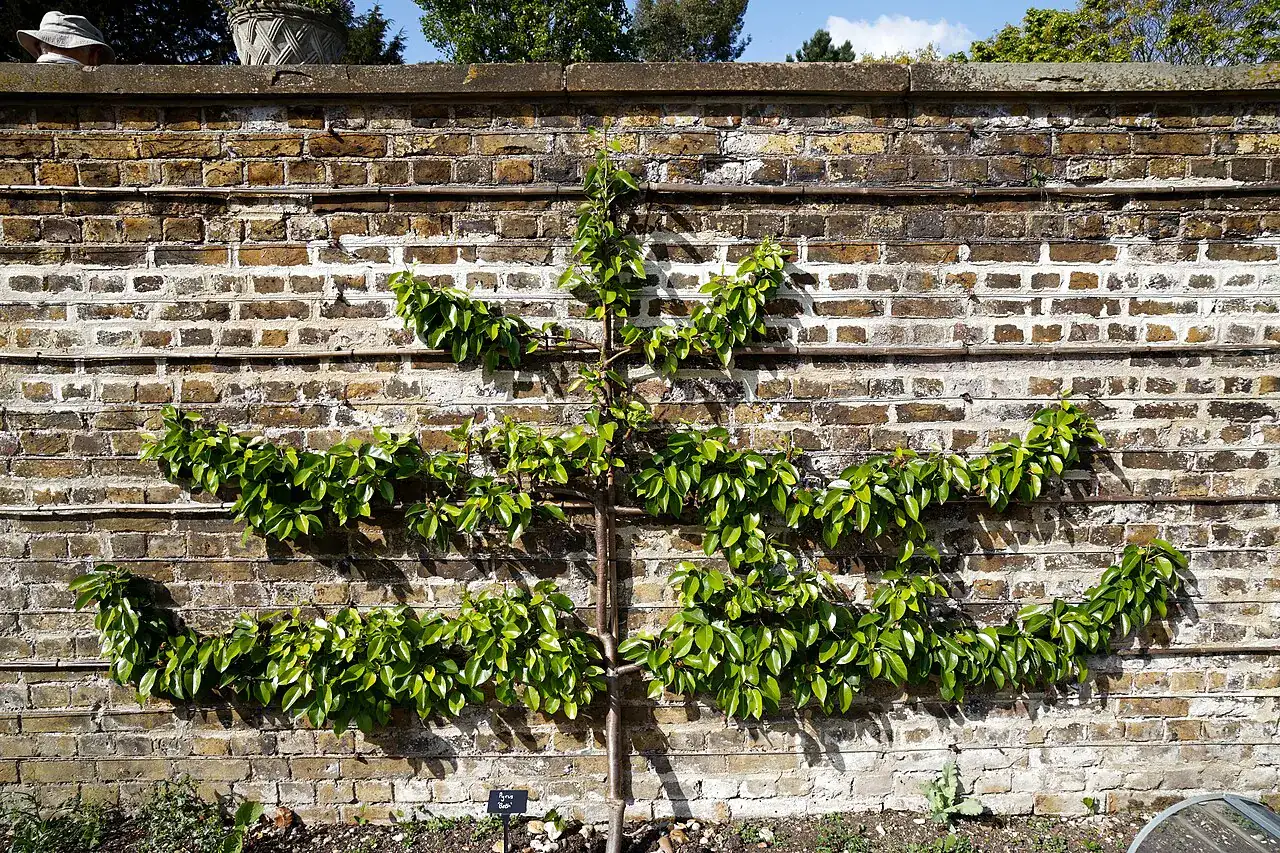
For a trained tree, such as an espalier or fan, decide whether you want to train it yourself from scratch. If so, the RHS starts with a one-year-old tree (a "maiden"). For a head start, it chooses a tree with several well-placed shoots growing from the central stem, or buys a partly trained tree from a specialist nursery.
Pollination
Most pears need a compatible pollinator, the RHS says. It can be a pear tree in a nearby garden, or a second variety you plant. Otherwise, choose a self-fertile or partly self-fertile variety.
The RHS pear facts page suggests asking a neighbour to plant a second tree, so you can share the harvest.
Spacing
The RHS spacings depend on the rootstock and the tree's shape. Free-standing trees go 3.5–5.5 m apart on Quince A and 2.5–3.5 m apart on Quince C or Eline. Espaliers and fans need at least 3.6 m. Cordons go about 75 cm apart.
Plant trained trees about 30 cm from the base of the wall, with the horizontal wires fixed in place before you plant.
How to plant and stake
The RHS says no soil preparation is generally needed before planting. If your soil is poor, dig a bucketful of organic matter into the soil you removed from the hole, then use it to backfill.
Support free-standing trees with tree stakes, putting them in place at planting time, the RHS says.
Watering and mulching for the first years
Water newly planted trees regularly in dry spells for the first couple of years, the RHS says. Water early in the morning or late in the evening, ideally with stored rainwater. Established trees in the ground usually need no watering, except in very dry spells while the fruit is swelling.
Each spring, the RHS spreads a thick layer of organic matter, such as garden compost or well-rotted manure, around the tree. Leave a small circle around the trunk clear to prevent rot. The pear facts page mulches newly planted trees in spring and autumn for the first three or four years.
Pruning a new tree
The RHS says to start pruning newly planted trees straight away. Free-standing trees are pruned in winter, trained trees in late summer. Our apple tree pruning guide covers the RHS winter pruning method for free-standing trees.
Planting a pear tree: the RHS advice at a glance
| What | Advice |
|---|---|
| When to plant | While dormant, from autumn to spring |
| Container-grown trees | Available all year and can be planted at other times, but autumn to early spring is preferable. Avoid hot, dry weather and frozen or waterlogged ground |
| Bare-root trees | Only available in winter and early spring, while dormant. Usually cheaper. Soak the roots in a bucket of water for half an hour |
| Site | Sunny and sheltered, open or against a wall or fence. Not in a late frost pocket |
| Rootstock Quince A | Semi-vigorous, 3–4.5 m. Suits espaliers |
| Rootstock Quince C or Quince Eline | Dwarfing, 2.5–3 m. Small gardens, cordons and containers |
| Spacing | Free-standing: 3.5–5.5 m on Quince A, 2.5–3.5 m on Quince C or Eline. Espaliers and fans at least 3.6 m. Cordons about 75 cm |
| Pollination | Most need a compatible pollinator nearby, or choose a self-fertile or partly self-fertile variety |
| Staking | Stake free-standing trees at planting time |
| Watering | Regularly in dry spells for the first couple of years |
How to do it
- Choose a sunny, sheltered spot. Avoid places prone to late frosts, which can damage the flowers.
- Decide on the rootstock: Quince A for a semi-vigorous tree of 3–4.5 m, Quince C or Quince Eline for a dwarfing tree of 2.5–3 m.
- Plant while the tree is dormant, from autumn to spring. Avoid hot, dry weather and frozen or waterlogged ground.
- Before planting, stand a bare-root tree in a bucket of water for half an hour, or give a container tree a good watering.
- You generally do not need to prepare the soil. If it is poor, dig a bucketful of organic matter into the soil you took out, and use it to backfill.
- Put a stake in at planting time for a free-standing tree. For a trained tree against a wall, fix horizontal wires first and plant about 30 cm from the base of the wall.
- Water regularly in dry spells for the first couple of years.
- Each spring, spread a thick layer of compost or well-rotted manure around the tree, leaving a small circle around the trunk clear.
Common questions
Can I plant a pear tree in autumn?
Yes. The RHS says the best time to plant a pear tree is while it is dormant, from autumn to spring.
Can I plant a pear tree in summer?
Only a container-grown one. The RHS says trees bought in containers can be planted at other times, but avoid hot, dry weather. Autumn to early spring is still preferable.
When can I buy bare-root pear trees?
The RHS says bare-root trees are only available in winter and early spring, while dormant. They are generally cheaper than trees in containers.
Do I need two pear trees?
Most pears need a compatible pollinator, the RHS says. A pear tree in a nearby garden can do the job. Or choose a self-fertile or partly self-fertile variety.
Which rootstock is best for a small garden?
Quince C or Quince Eline, the RHS says. They are dwarfing, reach 2.5–3 m, and suit small gardens, cordons and containers.
How far apart should I plant pear trees?
The RHS spaces free-standing trees 3.5–5.5 m apart on Quince A and 2.5–3.5 m on Quince C or Eline. Espaliers and fans need at least 3.6 m, cordons about 75 cm.
Sources
We wrote this page using the sources below.
- How to grow pears, Royal Horticultural Society (RHS)
- Fascinating facts and figures: pears, Royal Horticultural Society (RHS)