
 Lavender Pruning
How to prune lavender
Lavender asks for one thing every year: a trim after flowering. Give it that and it stays a compact, flowering dome. Skip it and you are left with leggy, woody stems that rarely grow back.
In short
Prune hardy lavender once a year, just after flowering: late summer, the RHS says. BBC Gardeners' World says typically August or September. Remove the spent flower stalks and about 2.5 cm of leafy growth. Never cut into the old woody stems, because lavender rarely regrows from them.

Why lavender needs a yearly prune
The RHS sums up lavender care in one line: prune annually to keep compact. There are three reasons behind it.
It keeps the plant in shape. BBC Gardeners' World says to cut lavender back after flowering to keep it compact and to stop it becoming too woody.
It keeps the flowers coming. Gardeners' World describes what happens otherwise. Lavender can become very leggy and bear few flowers, and it puts this down to a lack of pruning, or poor pruning. The RHS guide to pruning evergreen shrubs says the same of small shrubs such as lavender: pruning them every year improves flowering and helps prevent them from becoming too woody.
It cannot easily be put right later. The reason is in the next section.
One habit to avoid: only deadheading. Gardeners' World says many gardeners just deadhead their hardy lavenders, and that this also leads to leggy plants and not many flowers. Taking off the flower stalks is not enough. A little of the leafy growth has to come off with them.
If you are still at the planting stage, see when to plant lavender. For watering, pots in winter, pests and cuttings, see how to grow lavender. Pruning a hebe as well? See pruning hebe.
Lavender: what to do and when
Under cover and outdoors, for UK conditions. The weather differs from year to year and from north to south, so check your local conditions too.
The one rule: never cut into old wood
Every source on this page repeats the same warning.
- The RHS: lavender does not break new growth easily from old stems, so do not cut back into the woody stems. - BBC Gardeners' World: do not cut into old wood, as the plant will rarely regrow from such wood. - Its autumn pruning guide is blunter. Never cut back into old wood, as this can kill the plants.
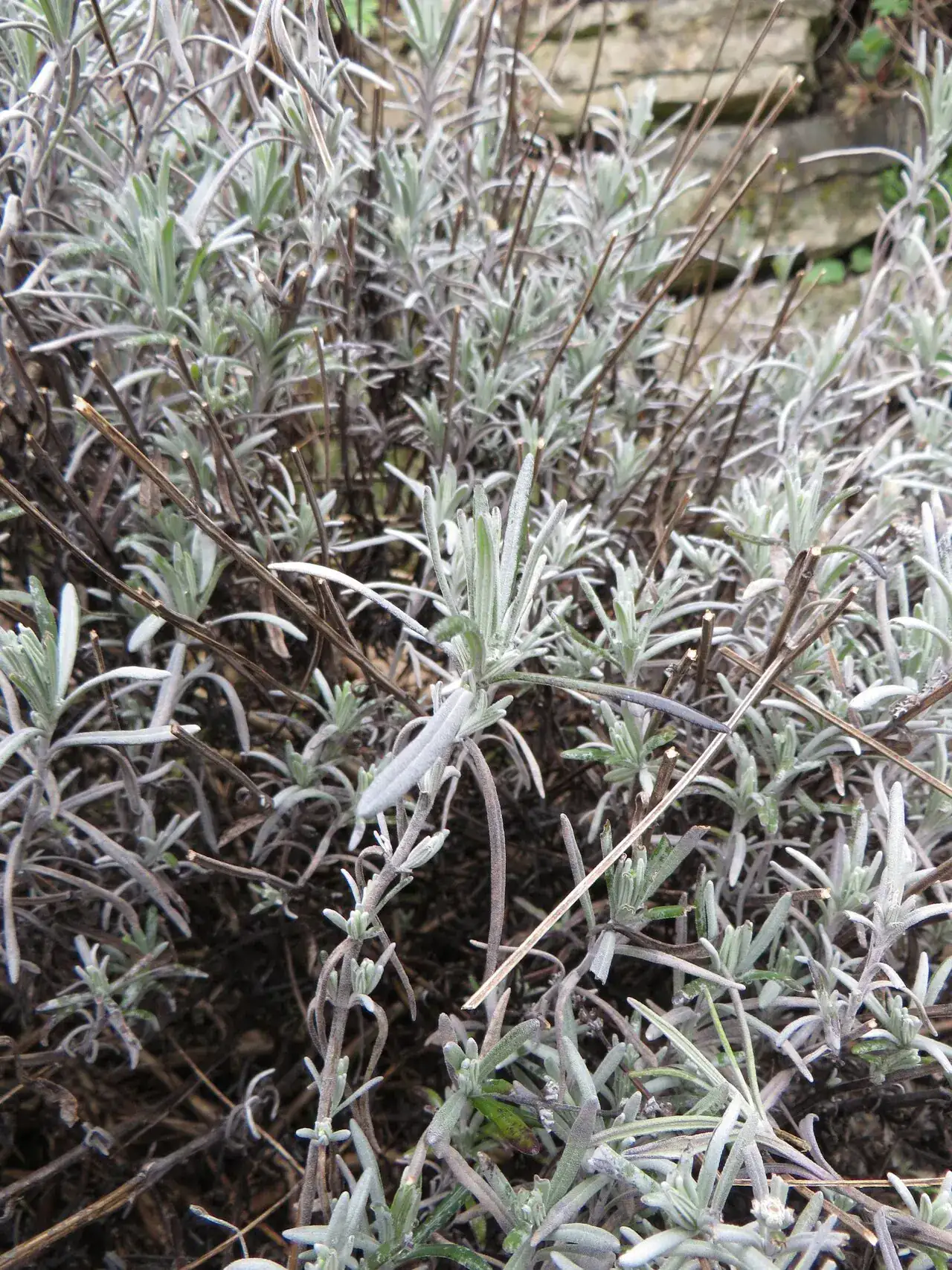
So before you cut, look at a stem. Find the leafy part and the bare, woody part below it. Your cut always goes in the leafy part.
This is why lavender is pruned a little every year, and not a lot every few years.
When to prune English lavender and lavandin
These are the hardy lavenders. The RHS says English lavender, *Lavandula angustifolia*, and its hybrids are the hardiest types. Gardeners' World groups English lavender with lavandin as the hardy types, and says they can cope with temperatures down to about −15 °C.
The RHS: late summer. It is best to trim them annually in late summer, just after flowering has finished.
BBC Gardeners' World: August or September. Prune after flowering, typically in August or September.
The two agree. The RHS names the season and the moment. Gardeners' World puts months on it.
Do not leave it until winter. Gardeners' World says Mediterranean shrubs like lavender should be cut back after flowering but before winter, and that lavender will not withstand pruning in winter. In its year-round pruning guide, lavender appears on the list of plants not to prune in winter.
Spring is for tidying only. The RHS adds one more date. The foliage can be clipped over in spring if growth is untidy or frost damaged.
How much to cut off

On timing the sources agree. On how much to remove, they sound different.
- The RHS growing guide: remove any spent flower stalks and about 2.5 cm of leaf growth. - The RHS guide to pruning evergreen shrubs puts lavender in a group where flowered shoots are removed to within 1.5–2.5 cm of the previous year's growth. - BBC Gardeners' World: cut back quite hard, but do not cut into old wood.
Read together, they describe the same limits from two ends. The RHS tells you the least to take: the stalks, and a little of the leaves. Gardeners' World allows more, quite hard, so long as you stop before the old wood.
If you are unsure, follow the RHS figure. It is the more cautious of the two.
The shape. Gardeners' World aims to end up with an even dome shape.
French lavender
French lavender is treated differently because it is less tough. The RHS says French and tender types are less hardy than English ones and tend to be short-lived. Gardeners' World calls French lavender half-hardy.
After the first flowers. Gardeners' World prunes it after the first flush of flowers has faded, but says to avoid pruning any later than early September.
In autumn, wait. The Gardeners' World autumn guide says simply: leave tender French lavender until spring.
A harder cut in April: what one guide says
One BBC Gardeners' World guide goes much further than the advice above. It is about pruning half-hardy shrubs in spring, and its introduction names French lavender among them. Under the heading "Lavender" it does not say which kind it means.
It says lavender can be pruned in April to keep it compact and to prevent it becoming woody. The method is specific.
1. Look for new green shoots appearing low down on the woody stems, below last year's grey growth. They usually appear in April, depending on the weather. 2. Cut the plant back by half to two-thirds of its original size. 3. Aim for an even dome shape.
This is far more than the RHS removes, which is the flower stalks and about 2.5 cm of leaf growth. The sources do not explain the difference. The guide's own limit is the same as everyone else's: lavender does not grow well if you prune into old, woody growth, so never cut below the lowest green shoots. If you are unsure, follow the RHS figure and prune after flowering.
Tender lavenders
Some lavenders are not hardy at all. The RHS describes specialist types that cannot be left outside over winter.
For these, Gardeners' World keeps pruning to a minimum. Deadhead, and prune only if the plants become scruffy.
Deadheading and cutting flowers for drying
Deadheading. The RHS cuts off spent blooms to encourage more to form. Late in the season it leaves them for the birds. Remember that on hardy lavender this is an extra, not a replacement for the yearly prune.
Cutting for drying. Lavender for drying is cut earlier than you might expect. BBC Gardeners' World gives the method.
- Cut the flower heads before the individual florets have opened. Choose long, well-developed spikes that are ready to open. - Cut just below the first leaves. - Pick off all the leaves and cut the stems to an even length. - Tie the bunch with soft string or raffia and hang it in a cool, dry place.
Gardeners' World names 'Grosso' as one often grown for use as a cut flower.
An old, woody lavender: can it be saved?
Sometimes. The sources are honest that the chances are not good.
The RHS does not offer a cure. It says older lavender plants can become straggly, very woody and misshapen, and that they are best replaced if you want to keep everything looking neat.
BBC Gardeners' World offers one attempt. Prune in mid-August to just above green shoots, and hope for the best. Then watch. If new shoots do not appear within the next month, it says, you might be better off starting again.
Notice what that advice does not say. It does not tell you to cut into bare wood. Even in a rescue, the cut stays above something green.
How long lavender lasts, and making new plants
Lavender is not a shrub for a lifetime, and the sources give different figures for it.
- The RHS guide to evergreen shrubs says small shrubs such as lavender are generally short-lived and will need replacing after 10 years or so. - BBC Gardeners' World says that, if pruned correctly, hardy types can live for about 15 years, and as many as 20 in some cases. It expects tender varieties to last about five years.
Both make the same point in the end. Pruning decides how many good years you get, and at some point the plant is replaced.
Replacements for free. Gardeners' World takes semi-ripe cuttings in late summer, which is also pruning time. Remove non-flowering shoots about 10 cm long, with a woody base and a tip of new growth. About 1–2 cm of stem should be below the surface of the compost. Cover the pots with a clear plastic bag and put them somewhere light and airy.
Lavender hedges
The RHS says lavender looks good as a low hedge or as edging to a border. For a hedge it spaces plants 30 cm apart, or 45 cm for larger cultivars.
Gardeners' World suggests 'Hidcote' for dwarf hedging, and 'Lullaby Blue', at around 60 cm tall, for a more substantial lavender hedge.
Neither source gives a separate pruning rule for a hedge. The advice on this page applies: every year after flowering, and never into old wood.
Pruning lavender by type
| Lavender | When | How much |
|---|---|---|
| English lavender and its hybrids | Late summer, just after flowering | Spent flower stalks and about 2.5 cm of leaf growth |
| Hardy types (English, lavandin) | After flowering, typically August or September | Cut back quite hard, but not into old wood |
| French lavender (half-hardy) | After the first flush of flowers, no later than early September | A prune after flowering |
| Lavender, type not named (guide to half-hardy shrubs) | April, once green shoots show low down | By half to two-thirds of its size, never below the green shoots |
| Tender lavender | Only if the plant becomes scruffy | Deadhead and tidy |
| Any lavender, untidy or frosted | Spring | Clip over the foliage |
| Old, woody, leggy plant | Mid-August | To just above green shoots. Replace if no new shoots within a month |
How to do it
- Wait until the flowers have finished, in late summer.
- Find where the leafy growth ends and the bare, woody stems begin. You will stay above that line.
- Cut off the spent flower stalks.
- Take off a little of this year's leafy growth as well. The RHS removes about 2.5 cm.
- Check that green leaves or shoots remain below every cut.
- Shape the plant into an even dome.
- In spring, clip over any foliage that is untidy or damaged by frost.
Common questions
When should I prune lavender in the UK?
The RHS says annually in late summer, just after flowering has finished. BBC Gardeners' World gives August or September for hardy types. One of its guides, on half-hardy shrubs, adds an April prune once new green shoots show low down. It does not say which lavender it means.
How far back can I cut lavender?
The RHS removes the spent flower stalks and about 2.5 cm of leaf growth. BBC Gardeners' World cuts back quite hard. Both say not to cut into the old woody stems, because lavender rarely regrows from them.
Can I prune lavender in winter?
No. BBC Gardeners' World lists lavender among plants not to prune in winter, and says it should be cut back after flowering but before winter.
Can I cut lavender back in spring?
The RHS says the foliage can be clipped over in spring if growth is untidy or frost damaged. One BBC Gardeners' World guide, on half-hardy shrubs, prunes lavender in April by half to two-thirds, once new green shoots appear low down. It does not name the type, and this is far more than the RHS removes.
My lavender is woody and leggy. What can I do?
BBC Gardeners' World suggests pruning in mid-August to just above green shoots. If new shoots do not appear within a month, it is better to start again. The RHS says old, woody plants are best replaced.
Is deadheading lavender enough?
No. BBC Gardeners' World says many gardeners just deadhead hardy types, and that this leads to leggy plants and not many flowers. Some leafy growth has to be removed too.
Sources
We wrote this page using the sources below.
- How to grow lavender, Royal Horticultural Society (RHS)
- Pruning evergreen shrubs, Royal Horticultural Society (RHS)
- How to grow lavender, BBC Gardeners' World Magazine
- Pruning half-hardy shrubs, BBC Gardeners' World Magazine
- What to prune in autumn, BBC Gardeners' World Magazine
- Year-round garden pruning guide, BBC Gardeners' World Magazine
- How to dry lavender, BBC Gardeners' World Magazine