
 Peonies Growing and care
How to grow peonies
A peony asks for a few minutes of attention three times a year: in spring, when the flowers fade, and in autumn. In return it flowers for years. The RHS calls peonies very long lived.
In short
Grow herbaceous peonies in full sun, in fertile soil that does not get waterlogged. Feed and mulch each spring, stake as growth emerges, and water only in the first year or in long dry spells. Cut the dead stems to the ground in autumn. They are fully hardy.

What peonies need
The RHS describes herbaceous peonies as long-lived, substantial perennials with large, brightly coloured, often double flowers. They are slow growing but rewarding, it says, with a brief but impressive flowering in late spring to early summer.
Its advice fits in one sentence: take care not to plant them too deep, and give them rich soil and plenty of sun.
In more detail:
- Full sun. Peonies do best in full sun. The RHS plant guide says they do not do well in shade. - Fertile soil. Improve it by digging in garden compost. Peonies grow well in a range of soils, including clay, as long as it does not get waterlogged. They do not do well on poor or very wet soils. - Room. Peonies are large plants and need about a square metre of space each, without competition from neighbouring plants. - To be left alone. Peonies dislike disturbance, the RHS says, so they should be left in their planting positions.
They are also tougher than they look. The RHS plant guide calls them drought-tolerant, and the growing guide calls them fully hardy.
When and how deep to plant is a subject of its own. It is covered in when to plant peonies. This page deals with the years after planting.
Peonies: what to do and when
Under cover and outdoors, for UK conditions. The weather differs from year to year and from north to south, so check your local conditions too.
Three kinds of peony
The care on this page is for herbaceous and intersectional peonies. It helps to know which you have.
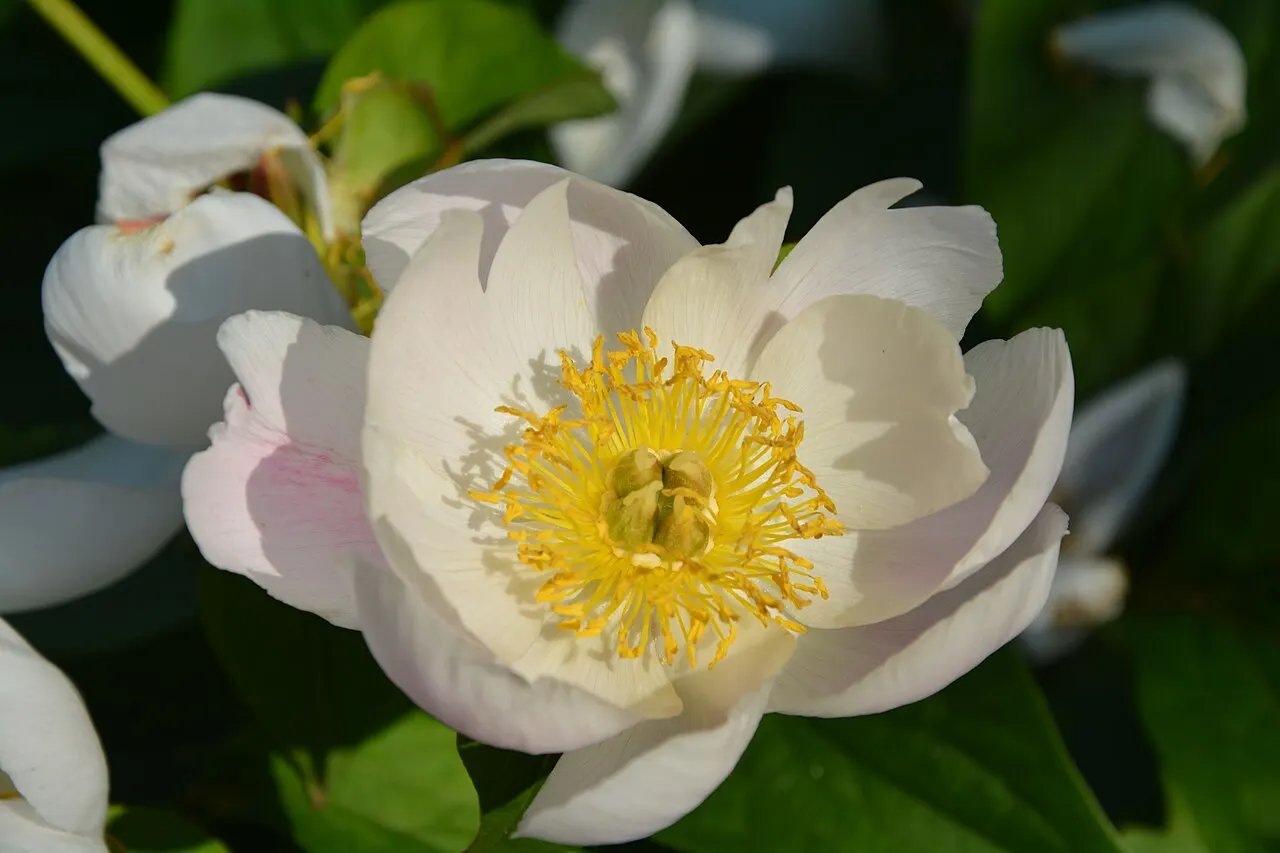
Herbaceous peonies. These die back to the ground each autumn. The flowers are single or double bowls in white, cream, pink, yellow and red, and reach up to 20 cm across. They are often spicily scented. The leaves come up with rich reddish tones in spring and often colour well in autumn.
Intersectional peonies. These are hybrids between tree and herbaceous peonies. The RHS says their foliage dies back in winter to leave a low, woody framework. The flowers are the largest of all the peonies, are produced over a longer period, and usually have distinctive blotches, called flares. The colour range is wider too, with apricot and purple shades. They are grown like herbaceous peonies and need similar conditions.
Tree peonies. These have an RHS guide of their own, with different rules for planting and pruning. There is a short section on them near the end.
Flower shapes. The RHS sorts peony flowers into four forms.
- Single: mostly cup-shaped, with one or two rows of large petals and a central boss of fluffy yellow stamens. - Semi-double: similar, but with two or three rows of petals. - Double: large, rounded flowers with narrower, overlapping, often ruffled petals that fill the centre. - Anemone-form: single or semi-double blooms where the central stamens are replaced by narrow, rippled, petal-like structures.
Watering
The first year. Water regularly in dry spells during the first year to help the plant establish, the RHS says, especially if it was planted in spring or summer.
After that. Established peonies are deep rooted and, after the first year, should not need routine watering.
The exception: a dry spring. Prolonged periods of drought in spring, the RHS warns, can cause poor flower bud development, or buds that fail to open. Its answer is to mulch around the base of the plant and to water during prolonged periods of dry weather.
BBC Gardeners' World gives the same pattern in its own words: water during dry spells for the first year, until established.
Peonies: growing conditions
Paeonia
- Position
- Full sun
- Soil
- Fertile, not waterlogged. Clay is fine
- Spacing
- 100 cm apart in the row, about 1 m apart (RHS)
- Watering
- Regularly in dry spells in the first year, then rarely
- Frost
- Fully hardy
- Height
- 0.5–1 m for most cultivars in the RHS plant guide
- Difficulty
- Easy
Feeding and mulching in spring
The RHS quick facts for herbaceous peonies put both jobs in one line: mulch and fertilise in spring.
Feed. To promote growth and flowers, the RHS applies a general-purpose fertiliser each year in spring, at 70 g per square metre.
Then mulch. Follow the feed with a layer of garden compost or well-rotted manure, to conserve moisture and suppress weeds. Our mulching guide has more on materials.
Keep the crown clear. Avoid covering the centre of the plant, the RHS says, as this could damage the buds.
A note on timing. A pop-up glossary note on the RHS page defines a mulch in general as a layer at least 5 cm thick, applied in late autumn to late winter. That is a general definition. The peony guide's own wording is spring, and this page follows it.
Do not overdo the feed. The RHS guide to staking perennials explains what happens if you do. Growing perennials on nutrient-rich soils, or overfeeding, encourages soft growth that is more likely to need additional support.
BBC Gardeners' World differs slightly on timing. It feeds peonies once a year in spring or autumn, with a general slow-release fertiliser. The RHS guide names spring only.
Staking

Many peonies have very large flower heads, the RHS says, so it is useful to support the stems by staking.
When. The RHS plant guide says it is usually advisable to stake the plants as soon as growth emerges in spring. Its guide to staking perennials gives the reason. Supports should ideally be inserted in spring, before plants have made too much growth. Later staking is difficult, because the growth is more advanced and can easily be damaged.
With what. The staking guide mentions peonies twice.
- Top-heavy plants such as herbaceous peonies and dahlias are well suited to growing through circular grid supports, or you can use Y-stake supports. - The flowers of peonies and dahlias can be too heavy, and may need to be staked individually.
How to tie. When you tie in a single stem, the RHS uses a figure-of-eight, so the string passes between the stem and the cane. Do not tie plants in too rigidly. They should be able to move in the wind.
Check as they grow. It may be necessary to keep tying in the stems, or to raise the supports, as the plant grows. Make sure supports for large clumps are well anchored in the ground.
After flowering and in autumn
Deadheading. Dead flowers can be removed after flowering using secateurs, the RHS says. Its plant pages for *Paeonia lactiflora* put it the same way: remove dead flowers as they fade.
Leave the leaves. After flowering, the foliage stays until autumn. BBC Gardeners' World says to wait for the foliage of herbaceous and intersectional peonies to die back fully before cutting to the ground.
Autumn cut. The foliage dies back in autumn. It is then best, the RHS says, to cut the foliage at ground level, to reduce the risk of infection from peony wilt. The quick facts say the same in five words: cut back dead stems in autumn. For every cut through the year, see how to prune peonies.
Winter. There is nothing to do. Peonies are fully hardy, the RHS says, so they do not need any winter protection. The plants stay dormant until spring. The RHS plant page for *Paeonia lactiflora* rates it H6: hardy in all of the UK and northern Europe, down to −20 to −15 °C.
Why a peony does not flower
The RHS gives three causes, and they are worth checking in this order.
Planted too deep, or in shade. Deep planting and a shady position may result in a lack of flowers. The buds of a herbaceous peony should have no more than 2.5 cm of soil over them. The cure is to move the plant in autumn to a more suitable position, to replant it shallower, or both. BBC Gardeners' World gives a different depth, with the bud tips 5 cm below the soil surface. The two sources differ here. This page follows the RHS figure, because the RHS says deep planting reduces flowering.
Recently moved. A moved plant can take a year or two to start flowering again. Divisions should flower two years after dividing.
A dry spring. Prolonged drought in spring can cause poor flower bud development, or buds that fail to open.
BBC Gardeners' World adds a fourth, which is simply time. It says peonies take several years to become established and to start blooming strongly.
Old clumps. If flowering declines on an old plant, the RHS rejuvenates it by lifting and dividing in late autumn. The method is in when to plant peonies.
Peony wilt and other problems
Peony wilt. The RHS growing guide calls this the only serious disease of peonies. It is caused by the fungus *Botrytis paeoniae*, a close relative of grey mould, and it attacks only peonies. Tree peonies get it too.
What you see, according to the RHS:
- On leaves: irregular patches of dead, brown tissue. In wet conditions they spread and the leaves collapse. - On stems: patches of infection that lead to the collapse of leaves or buds. - On flowers: infection often occurs just below the bud, which then hangs down and fails to open. - In wet weather: a fuzzy grey mould on the affected parts.
The disease generally appears in spring or early summer. The fungus forms black, seed-like resting structures in the tissue it kills. These fall to the soil with the dead tissue and stay there until the following spring.
What to do:
- Remove all infected material promptly, and burn it or send it to landfill. This reduces the airborne spores and stops the resting structures reaching the soil. - Cut the foliage to ground level in autumn, as described above. - Accept that hygiene has limits. The RHS says it will reduce the risk but not eliminate it, because the spores are airborne and may blow in from elsewhere.
There are no chemical controls available to gardeners, the RHS says.
Peony blotch. The fungus *Septoria paeoniae* causes grey-brown spotting with red margins on the foliage. The RHS says it is not a serious problem.
Ants. They may be found on the flower buds, but do not cause any damage.
The longer list. The RHS plant pages for *Paeonia lactiflora* add that peonies may be susceptible to leaf and bud eelworm, the soil-dwelling larvae of swift moths, a virus, honey fungus and Verticillium wilt.
Making more peonies
Division. Most commonly grown peonies are hybrids and do not breed true from seed, the RHS says, so they are usually increased by division. It is best to leave a clump undisturbed until flowering starts to decline. Then divide it in autumn, keeping at least three dormant growth buds and some roots on each piece. The steps are on our planting page.
Seed. Wild species can be grown from seed. So can hybrids, but the seedlings will differ from the parent. The RHS method:
1. Collect ripe seed once the pods begin to split, in late summer and autumn. 2. Keep the black seed. It is the viable one. Red seed has not been fertilised and will not germinate. 3. Sow soon after collecting, 2.5 cm deep, in containers of John Innes seed compost. 4. Wait. Peony seeds need two chilling periods with a warm spell between them.
Seedlings can take up to five years to reach flowering size.
Peonies in pots, and which to choose
Pots. Being deep rooted, the RHS says, peonies do not make good plants for containers. It says this of herbaceous and intersectional peonies alike.
Choosing. Pick a peony for flower colour and shape, the RHS suggests. Colours run from white through pink to dark red and yellow.
Herbaceous peonies in the RHS plant guide with its Award of Garden Merit include 'Sarah Bernhardt', 'Festiva Maxima', 'Duchesse de Nemours', 'Shirley Temple' and 'Coral Charm'. All are listed at 0.5–1 m high. The RHS describes 'Sarah Bernhardt' as having fragrant, rose-pink double flowers 20 cm in width, with ruffled inner petals.
For something smaller, the guide lists the Majorcan peony, *Paeonia cambessedesii*, at 0.1–0.5 m.
Intersectional peonies with the award include 'Bartzella', 'Cora Louise' and 'First Arrival'.
Buying. The widest range comes from specialist nurseries, often as bare-rooted divisions in late autumn. Garden centres sell plants in pots from late spring to early summer.
Tree peonies, briefly
The RHS treats tree peonies in a separate guide. The main points of care:
- Site. A sunny or lightly shaded position, sheltered from cold winds. They prefer neutral, humus-rich, well-drained soil. - Watering. As for herbaceous peonies: regularly in dry spells in the first year, then no routine watering. - Feeding. Annual mulching should be sufficient. If growth is poor or the plant is not flowering well, apply a general-purpose fertiliser in spring, following the maker's instructions. - Mulch. In spring, the quick facts say. Do not pile it against the stems, as they may rot. - Pruning. Minimal. Remove flowered shoots in summer, cutting just above the new growth. Remove dead shoots in late winter, cutting back to a healthy bud. More in pruning peonies. - Suckers. Shallow planting can encourage the rootstock to sucker. Remove suckers as soon as they appear, at the point of origin, with a sharp knife. - Frost. The plants are fully hardy, but emerging foliage and flower buds can be damaged by late frosts. Affected leaves and buds may blacken and fail to open, so avoid frost pockets. - Patience. Tree peonies can take up to four years to settle in and flower.
A word on safety
The two RHS growing guides for peonies carry no toxicity note. The RHS plant pages for *Paeonia lactiflora* and its cultivar 'Sarah Bernhardt' do. Under toxicity they say: "Pets (dogs, cats): Skin irritant." For more on pets, the RHS pages point to the HTA guide to potentially harmful plants.
Cheat sheet: growing herbaceous peonies
| What | Advice |
|---|---|
| Site | Full sun, with about a square metre of space each |
| Soil | Fertile, improved with garden compost. Clay is fine if it does not get waterlogged |
| Watering | Regularly in dry spells in the first year. After that, no routine watering |
| Feeding | General-purpose fertiliser each spring, 70 g per square metre |
| Mulch | In spring, garden compost or well-rotted manure, not over the centre of the plant |
| Staking | As soon as growth emerges in spring |
| After flowering | Dead flowers can be removed with secateurs |
| Autumn | Cut the dead foliage at ground level |
| Winter | Fully hardy. No protection needed |
| Pots | Being deep rooted, peonies do not make good plants for containers |
How to do it
- Grow peonies in full sun, in fertile soil, and give each plant about a square metre to itself.
- In its first year, water a new peony regularly in dry spells.
- Each spring, apply a general-purpose fertiliser at 70 g per square metre.
- Then mulch with garden compost or well-rotted manure. Keep the mulch off the centre of the plant.
- Put supports in as soon as growth emerges in spring, before the stems are tall.
- After flowering, remove the dead flowers with secateurs.
- When the foliage dies back in autumn, cut it off at ground level and clear it away.
- Leave the clump alone for years. Lift and divide it only when flowering declines.
Common questions
Are peonies easy to grow?
The RHS calls them slow growing but rewarding. Take care not to plant them too deep, it says, and give them rich soil and plenty of sun. Established plants are fully hardy, deep rooted and very long lived.
When should I feed peonies?
In spring. The RHS applies a general-purpose fertiliser each year in spring at 70 g per square metre, then mulches with garden compost or well-rotted manure, keeping it off the centre of the plant.
Do peonies need a lot of water?
No. The RHS waters regularly in dry spells during the first year. After that, established peonies are deep rooted and should not need routine watering, except in prolonged dry weather in spring.
When should I stake peonies?
Early. The RHS plant guide says it is usually advisable to stake as soon as growth emerges in spring. Its staking guide suggests circular grid supports that the stems grow through, or Y-stakes.
When do I cut peonies back?
In autumn, once the foliage has died back. The RHS cuts it at ground level to reduce the risk of infection from peony wilt. Dead flowers can be removed after flowering. See [pruning peonies](/peonies/pruning/).
Do peonies need winter protection?
No. The RHS says herbaceous peonies are fully hardy and do not need any winter protection. They stay dormant until spring.
Can I grow peonies in pots?
They are not well suited to it. Being deep rooted, the RHS says, peonies do not make good plants for containers.
Sources
We wrote this page using the sources below.
- How to grow herbaceous and intersectional peonies, Royal Horticultural Society (RHS)
- Herbaceous peonies (plant guide), Royal Horticultural Society (RHS)
- Intersectional (Itoh) peonies (plant guide), Royal Horticultural Society (RHS)
- Peony wilt, Royal Horticultural Society (RHS)
- Perennials: staking, Royal Horticultural Society (RHS)
- How to grow tree peonies, Royal Horticultural Society (RHS)
- Paeonia lactiflora (plant details), Royal Horticultural Society (RHS)
- Paeonia lactiflora 'Sarah Bernhardt' (plant details), Royal Horticultural Society (RHS)
- How to grow peonies, BBC Gardeners' World Magazine