
 Dahlias Growing and care
How to grow dahlias
Dahlias flower from midsummer until the frost stops them, and they ask for two things in return: a summer of water, stakes and deadheading, and a dry bed for the winter.
In short
Grow dahlias in a warm, sheltered, sunny spot in fertile, free-draining soil. Stake them, pinch out the main tip, water in dry weather and deadhead weekly. After the first frost blackens the leaves, lift the tubers, dry them upside down and store them in a cool, dark, frost-free place.

Dahlias at a glance
- Position
- A warm, sheltered, sunny spot
- Soil
- Fertile, moist, free-draining
- Spacing
- 60 cm apart in the row, at least 60 cm between plants, more for larger cultivars (RHS)
- Plant
- Late May; early to mid-June in colder regions
- Watering
- Thirsty: extra water in dry, hot weather; regularly in containers
- Frost
- Tender: tubers do not reliably survive British winters in the ground
- Height
- Bedding types to 60 cm, most about 1.2 m, a few over 2 m
Dahlias: what to do and when
Under cover and outdoors, for UK conditions. The weather differs from year to year and from north to south, so check your local conditions too.
What dahlias need
Dahlias come from Mexico and Central America, the RHS says. They are tender perennials that grow from underground tubers. The top growth dies back in winter and comes again in spring.
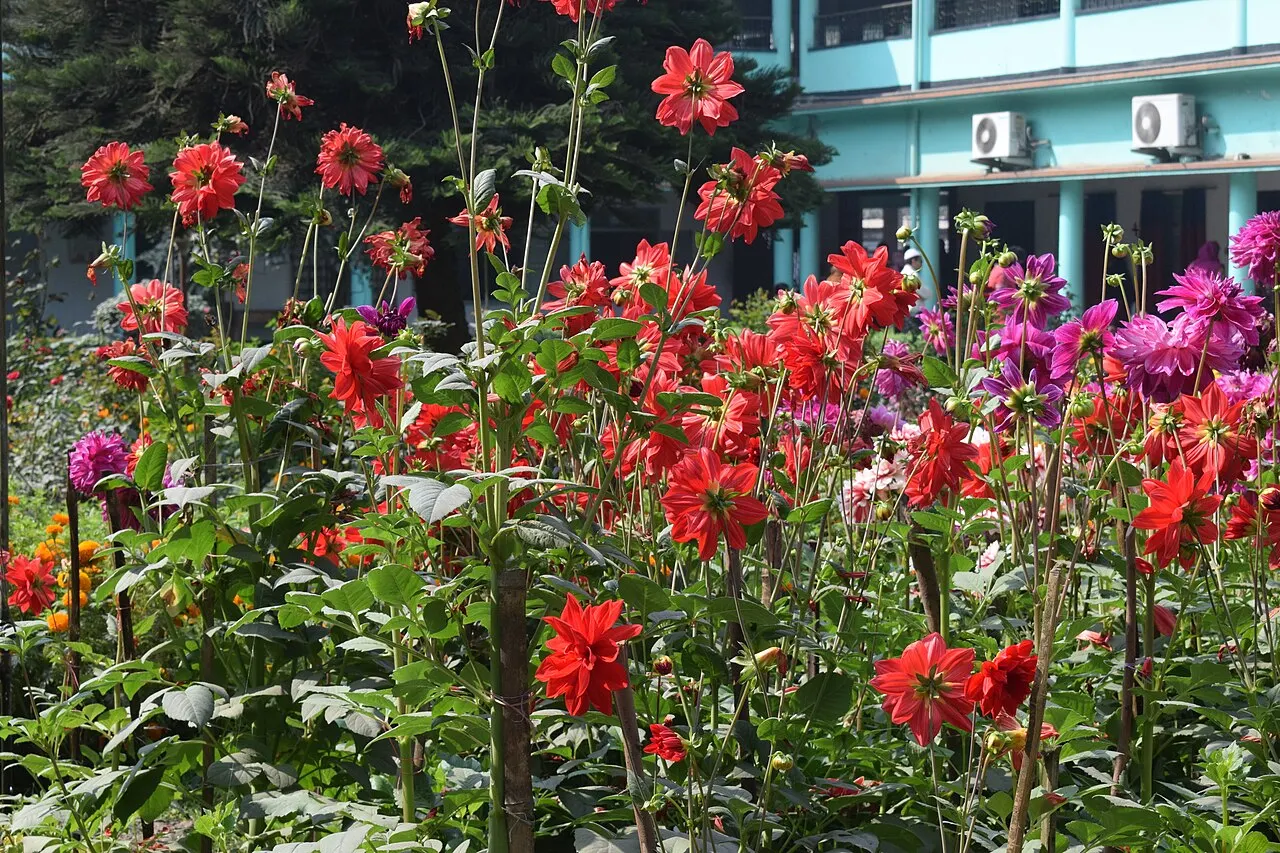
Their size varies enormously. The RHS gives flowers from 5 cm to 30 cm across. Bedding types reach up to 60 cm, most dahlias about 1.2 m, and a few more than 2 m. They flower from summer through autumn, until the first frosts. Gardeners' World gives July to October in a border.
The spot. Warm, sheltered and sunny, the RHS says. Gardeners' World asks for as much sun as possible and calls a south or west facing border ideal.
The soil. Fertile, moist and free-draining. Avoid waterlogging, which can rot the tubers. Gardeners' World adds well-rotted organic matter, and grit in the planting hole on heavy clay.
Space. At least 60 cm between plants, and more for the larger cultivars.
Soil also decides what you do in autumn. The RHS says tubers are more likely to survive the winter outdoors on lighter soils. Heavy soils are colder and wetter, so tubers there should be lifted.
Starting tubers and planting out
Planting has a page of its own: when to plant dahlias. In short, there are two routes.
Start them indoors. Gardeners' World pots up tubers in late March or early April, just below the surface of the compost, with the old stem or new shoots facing up. Keep them in a light, frost-free place. Shoots should show after about five weeks. The RHS waters lightly and sparingly at this stage, because overwatering causes rot.
Or plant tubers straight outside. The RHS says tubers can go directly into the ground in mid to late April. Shoots typically appear by early June, a little behind plants started indoors.
Planting out growing plants. Harden them off first. The RHS plants out when there is no risk of frost, usually late May, or early to mid-June in colder regions. Gardeners' World says mid to late May, once no more frosts are forecast.
After planting, water in and mulch, leaving a gap around the stems. Protect the new shoots from slugs and snails, which favour young growth.
Staking and pinching out

Staking. Dwarf bedding dahlias need no support. Most others do. The RHS uses strong bamboo canes, either one per stem or four in a square around the clump, tied with twine. Giant dahlias get stout posts. Gardeners' World ties in the new growth every week or two as the plant grows.
Pinching out. Removing the main growing tip makes the plant branch, and more branches mean more flowers. On when to do it, the two sources differ.
- The RHS pinches out when the main stem reaches about 40 cm, cutting above a pair of leaves. - Gardeners' World pinches out when the plant is about 20 cm tall, removing the central shoot down to the top pair of leaves.
Either way the principle is the same: take out the leader once the plant is growing strongly, and take it back to a pair of leaves.
Thinning the stems. In June or July, the RHS thins each plant to seven to ten sturdy stems. Giant-flowered types are kept to three to five, which gives larger blooms. Gardeners' World thins earlier, at planting, leaving about five shoots per tuber and using the spare ones as cuttings.
Disbudding is only for showing or for cut flowers. Remove the smaller buds beside the largest central one. Border plants do not need it.
Watering and feeding
Water. Dahlias are thirsty plants, the RHS says. In the ground they need extra water in dry, hot weather. In containers they need regular watering all through the growing season, because pots dry out faster. Gardeners' World waters well once a week.
Feed: the sources differ.
- The RHS says that for dahlias in the ground, a mulch of organic matter, preferably homemade compost, is usually sufficient. It feeds dahlias in containers with a potassium-rich liquid feed, such as tomato feed, every two weeks from early July to early September. - Gardeners' World feeds once a fortnight with a high potash feed such as tomato feed, and does not limit this to pots.
The RHS also warns against the wrong kind of feeding. Excess nitrogen gives leafy growth with few flowers. If a plant in the ground flowers poorly, the RHS remedy is a fortnightly potassium-rich feed, a check that it has enough sun and a check that the roots are not dry.
Deadheading and cutting
Deadhead often. The RHS says regularly, ideally once a week, cutting back to a leaf joint lower down the stem. Gardeners' World removes the whole flowering stem.
Bud or spent flower? Both sources give the same trick for telling them apart. Buds are rounded. Spent flowers are pointed.
Cut for the house. Gardeners' World says cutting flowers encourages more blooms, and that the time to cut is when the flowers are fully open.
For the bees. Single-flowered dahlias are best for pollinators, the RHS says. Gardeners' World says that most dahlias, because of their complex flowers, are not attractive to pollinators.
Growing dahlias in pots
Bedding types suit containers best, the RHS says.
Pot size. The RHS uses a container around 50 cm wide, with one standard dahlia in it or up to three small bedding dahlias. Gardeners' World gives a minimum of 30 cm wide and deep, and suggests about 35 cm high and wide for dahlias up to 1 m tall. It advises against very tall varieties in pots.
Compost. Peat-free multipurpose compost. Gardeners' World mixes in well-rotted manure.
Care. Water regularly, feed every two weeks from early July to early September, and stake.
Winter: leave in the ground or lift?

This is the November question. Dahlias are tender, and Gardeners' World says plainly that they do not reliably survive British winters.
The RHS says that after the first frosts have damaged the foliage, you either leave the tubers in the ground or lift them. If frosts come late, lift by late November.
Leaving them in. The RHS calls this the easiest option, but one that carries risk, especially in a harsh or very wet winter. Cut the stems down and cover the crowns with mulch such as homemade compost, chopped stems or bark chippings. Gardeners' World uses mushroom compost or straw and rakes it away in spring.
How thick? The RHS dahlia guide says 15 cm. The RHS guide to overwintering tender plants says a thick, dry mulch of at least 5 cm. The thicker figure is the one written for dahlias.
Where it works. In mild areas, both RHS guides say, and in sheltered, well-drained parts of the garden. Gardeners' World says that in the south you may get away with it, while in the north, or in a particularly long, cold winter, the tubers may rot and need replacing.
The price. The RHS notes that mulched plants may come into growth and flower a little later than those lifted, stored and replanted.
When to lift without question. In cold, wet or very frosty areas, Gardeners' World says. On heavy soil, the RHS says.
How to lift and store dahlia tubers
When. Once the foliage has been damaged by the first frosts, the RHS says. Gardeners' World waits until frost has blackened it.
Cut back. The sources give different lengths. The RHS dahlia guide cuts the stems to 5–15 cm. The RHS overwintering guide says 5 cm from the base. Gardeners' World says about 12 cm. Any of these leaves a short handle of stem.
Lift. Loosen the plant with a fork. Take care not to damage, cut or bruise the tubers, because the RHS says this can cause rots in storage. Trim away thin roots and any damaged tubers.
Clean: the sources differ. The RHS shakes off as much soil as possible. One Gardeners' World guide removes it with the fingers. Another rinses the tubers thoroughly with a hose or in a bucket. If you rinse, the drying that follows matters all the more.
Dry upside down. Stand the tubers upside down so that moisture drains out of the hollow stems. The RHS says a few weeks, in a cool spot. Gardeners' World says a couple of weeks, in a tray lined with newspaper.
Pack. Shallow crates, trays or open boxes. Cover the tubers with dry compost, sand, straw or newspaper, the RHS says. Gardeners' World also suggests vermiculite. It stresses that the compost must be dry, because damp compost causes rot. The RHS overwintering guide leaves only the old flower stalks showing.
Store. A dark, cool, frost-free place such as a shed or garage. The RHS defines frost-free as a night minimum of 4 °C. In very cold spells, cover the boxes with newspaper or fleece.
Check. Look them over regularly, the RHS says, and remove any tuber that is rotting.
Spring: waking them up, dividing and cuttings
Start them off. Stored tubers can be started in containers indoors or in a greenhouse in spring, the RHS says. Gardeners' World pots them up in late March or early April.
Divide. The RHS method starts in February. Set the tubers in a shallow tray of peat-free compost. When the shoots are about 2.5 cm tall, divide the clump so that each piece has roots and shoots. Pot the pieces up and grow them on in a bright, frost-free place until late May or early June.
Take cuttings. In late winter to early spring, pot up tubers and warm them on a windowsill or in a heated propagator. Take cuttings from healthy, vigorous shoots. Gardeners' World says each tuber yields about five new plants this way.
Problems to watch for
- Slugs and snails go for the young shoots. Gardeners' World suggests planting out larger plants. - Earwigs. Gardeners' World pushes a cane into the soil and puts an upturned pot stuffed with straw on top. Earwigs hide in it by day and can be removed. - Aphids, blackfly in particular, colonise soft new growth, the RHS says. - Powdery mildew develops in dry conditions. Keep plants well watered. - Curled or distorted leaves. Check for pests first. If there are none, Gardeners' World says mosaic virus or botrytis may be the cause. There is no cure, and the plant has to be destroyed. - A snapped stem. Gardeners' World cuts it back to a pair of leaf nodes. New stems usually grow from the base if the tubers are healthy. - Tuber rot in store. Follow the lifting steps: no bruises, a proper drying, dry packing and regular checks.
Leave dahlias in the ground or lift them?
| Leave in the ground | Lift and store | |
|---|---|---|
| Where it suits | Mild areas; sheltered, well-drained spots; lighter soils | Cold, wet or very frosty areas; heavy soils |
| What to do | Cut the stems down and cover the crowns with mulch | Cut back, lift, dry upside down, pack in dry compost or sand |
| How much mulch | 15 cm (RHS dahlia guide); at least 5 cm (RHS overwintering guide) | None |
| Risk | Losses in a harsh or very wet winter | Rot in store if tubers are damaged or damp |
| Next summer | May start into growth and flower a little later | Can be started early indoors and divided |
How to do it
- Wait until the first frosts have blackened the foliage. If frost comes late, lift by late November.
- Cut the stems back. The RHS dahlia guide leaves 5–15 cm.
- Loosen the clump with a fork, taking care not to cut or bruise the tubers. Lift it and shake off as much soil as you can.
- Stand the tubers upside down in a cool, dry place for a few weeks so that moisture drains from the hollow stems.
- Pack them in shallow crates or boxes and cover with dry compost, sand, straw or newspaper.
- Store in a dark, cool, frost-free place such as a shed or garage.
- Check regularly through winter and remove any tuber that is rotting.
Common questions
Do I have to lift dahlias for the winter?
Not everywhere. The RHS says you can leave them in the ground under 15 cm of mulch, but it is a risk in a harsh or very wet winter. In cold, wet or very frosty areas and on heavy soil, lift them.
When should I lift dahlia tubers?
Once the first frosts have damaged the foliage, the RHS says. If frosts come late, lift by late November.
How do I store dahlia tubers over winter?
Dry them upside down for a few weeks, then cover them with dry compost, sand, straw or newspaper in shallow boxes. The RHS keeps them in a dark, cool, frost-free place such as a shed or garage and checks them regularly.
Should I wash dahlia tubers before storing?
The sources differ. The RHS shakes off as much soil as possible. One Gardeners' World guide rinses the tubers with a hose or in a bucket, then stands them upside down to dry before packing them in dry compost.
When do I pinch out dahlias?
The RHS pinches out the main tip above a pair of leaves when the stem reaches about 40 cm. Gardeners' World does it at about 20 cm. Both do it to make the plant branch and flower more.
What do I feed dahlias?
A potassium-rich liquid feed such as tomato feed. The RHS gives it to dahlias in containers every two weeks from early July to early September, and says a compost mulch is usually enough for plants in the ground.
When can stored dahlias go back outside?
When there is no risk of frost. The RHS gives late May, or early to mid-June in colder regions. Gardeners' World says May, once all risk of frost has passed.
Sources
We wrote this page using the sources below.
- How to grow dahlias, Royal Horticultural Society (RHS)
- Overwintering tender plants: lifting or mulching, Royal Horticultural Society (RHS)
- How to grow dahlias, BBC Gardeners' World Magazine
- How to lift and store dahlias, BBC Gardeners' World Magazine