
 Jasmine Pruning
When to prune jasmine
The word jasmine covers a summer climber, a winter shrub and a borrowed name. Each flowers at a different time, so each has its own pruning date, and getting it wrong costs you next year's flowers.
In short
Prune straight after flowering. The RHS times summer jasmine (Jasminum officinale) for late summer or early autumn, and winter jasmine (J. nudiflorum) for spring, immediately after its yellow flowers. Cut flowered stems back to a strong side-shoot lower down, and thin out weak or overcrowded growth.

The short answer: prune straight after flowering
Every jasmine is pruned once it has finished flowering. The RHS gives two dates:
- Summer jasmine (*Jasminum officinale* and *J.* × *stephanense*): just after flowering, in late summer or early autumn. - Winter jasmine (*J. nudiflorum*): in spring, immediately after flowering.
Why the timing matters. The RHS explains that summer jasmine forms its early flowers on last year's growth and its later flowers at the tips of the current year's shoots. Pruning after flowering gives the new growth time to mature and flower early the following season. Winter jasmine flowers on last year's growth too.
Our reading: a cut straight after flowering leaves the plant a full season to grow the stems that will flower next time. Cut summer jasmine in spring, or winter jasmine in autumn, and you remove the stems that were about to flower.
Jasmine: what to do and when
Under cover and outdoors, for UK conditions. The weather differs from year to year and from north to south, so check your local conditions too.
Which jasmine have you got?
Before you cut, check which plant you have. They look quite different:
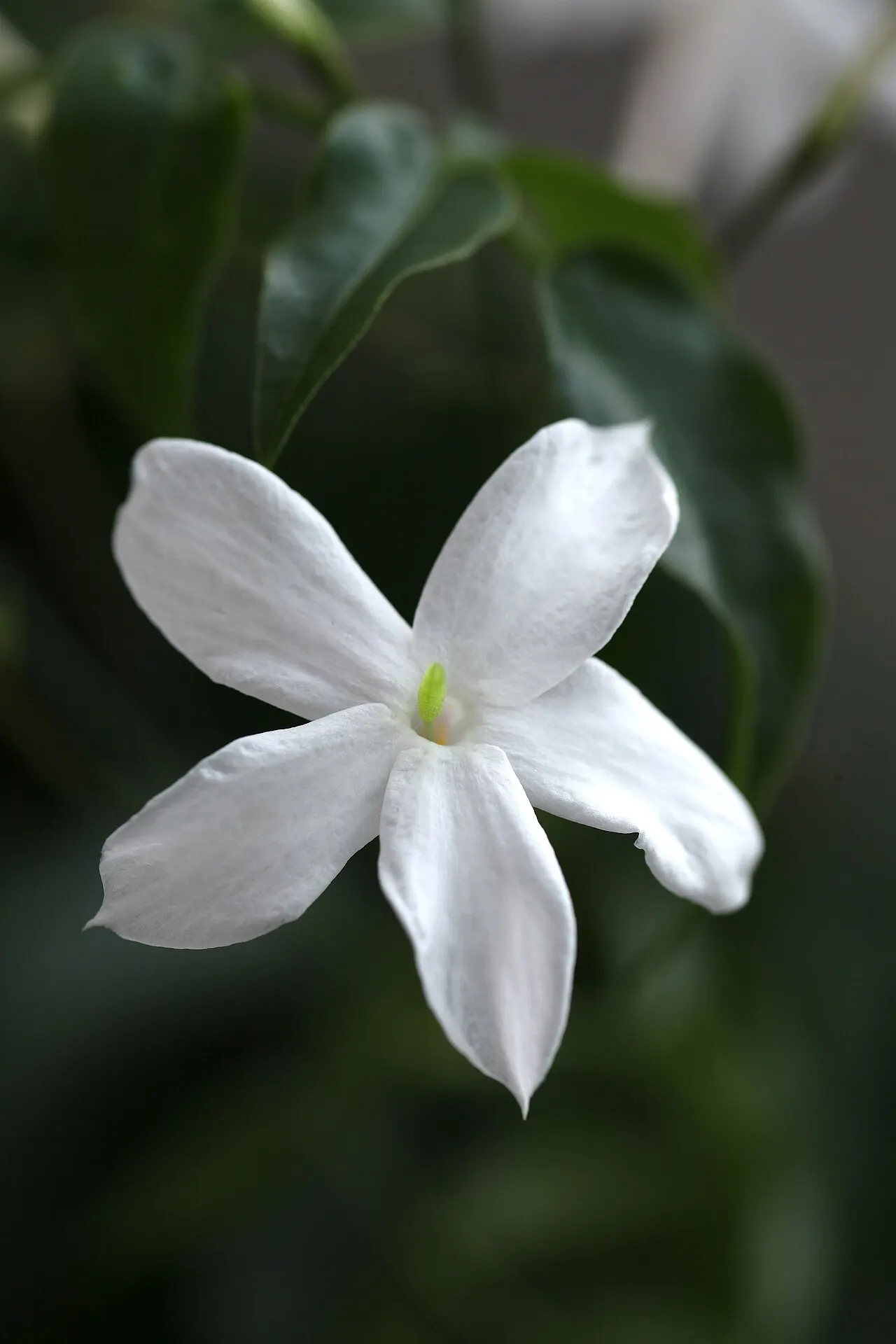
Common or summer jasmine (*J. officinale*) is a vigorous climber with small, fragrant white flowers. The RHS plant entry says the flowers are about 2 cm across, in clusters of 3 to 10, in summer and early autumn. It grows 4–8 m tall, and up to 12 m. Trees and Shrubs Online, the International Dendrology Society's reference, gives its flowering season as June to October.
Winter jasmine (*J. nudiflorum*) is a shrub with long, arching stems. Its bright yellow flowers, up to 2.5 cm across and unscented, open on bare stems in winter and early spring. It reaches 1.5–2.5 m in height and spread, and the RHS says it needs no support.
Chinese jasmine (*J. polyanthum*) is a tender plant with highly fragrant white flowers opening from pink buds. The RHS grows it indoors, ideally in a conservatory.
Star jasmine (*Trachelospermum jasminoides*) belongs to a different genus, *Trachelospermum*, despite its common name. It is an evergreen climber with its own pruning advice, covered further down.
How to prune summer jasmine
The RHS method for summer jasmine is simple:
1. Cut back the flowered stems to a strong side-shoot lower down. 2. Thin out overcrowded, damaged or wayward shoots. 3. Remove weak stems.
The RHS plant entry for *J. officinale* puts it in one line: prune out thin, old shoots after flowering.
Why bother every year? The RHS says annual pruning keeps the plant healthy and moves the flowers lower down, where you can smell them.
A bush instead of a climber. Trees and Shrubs Online describes an older approach: in the south, common jasmine pruned back every spring will make a self-supporting bush. That is a different aim from a flowering climber. Where the sources differ: for flowers on a wall or pergola, follow the RHS and prune after flowering.
Support. The RHS says summer jasmines need large, sturdy supports, because they can grow vigorously on walls, pergolas, trellis, archways and porches. Newly planted climbers need some training and pruning so they spread evenly over their supports.
How to prune winter jasmine
When: in spring, as soon as the yellow flowers are over, the RHS says.
How: the same as summer jasmine. Cut the flowered stems back to a strong side-shoot lower down, and take out damaged, weak and overcrowded shoots.
Ways to grow it. The RHS says winter jasmine can be grown as a hedge, as ground cover, or trained against a wall. Its plant entry suggests coastal planting, ground cover and wall-side borders, and says it can be propagated by layering. It tolerates sun or partial shade, grows in any aspect, and is fully hardy, with an RHS rating of H5 (−10 to −15 °C).
Our reading: against a wall, tie the arching stems you want to keep onto wires or trellis after pruning. As ground cover, you can be rougher and simply cut back the stems that have flowered.
Star jasmine: little or no pruning
Star jasmine is the plant many people mean when they ask about jasmine on a fence, so here is the RHS advice for it too.
Routine pruning. The RHS says star jasmine is not a vigorous grower, so little or no pruning or training is usually needed. Any maintenance pruning is done in spring.
Young plants may need some guiding and tying in until they twine and climb on their own.
An overgrown plant can be hard pruned or renovated in spring. The RHS says to cut back shoots by two-thirds, to a sideshoot or flowering spur, and then thin out some of the new shoots.
Site. A south- or west-facing wall or fence is ideal, in sun or light shade, sheltered from cold, drying winds. In cold snaps the leaves may turn red, develop spots or even fall, the RHS says, but the plant should recover except in the severest winters.
Cutting back an overgrown jasmine
Summer and winter jasmine both tolerate hard pruning, the RHS says. A tangled plant can be cut back to within 60 cm of the base.
What happens next. Regrowth is vigorous. Choose strong shoots to form a new framework, tie them in, and remove the ones you do not want.
The cost. The RHS warns that the plant will take two or three years to start flowering again.
Our reading: if the plant is only overgrown on one side, or you cannot do without flowers for two years, prune harder than usual after flowering for a couple of seasons instead, taking the oldest stems out first.
Nesting birds. A dense climber is an ideal nest site. The RHS jasmine guide gives the main nesting season as early March to the end of July, and says to check before pruning and to delay if you find an active nest. The RHS hedge guide gives the season more widely, as usually March to August. Both dates catch the winter jasmine prune in spring.
After pruning: feeding, mulching, watering
In the ground. The RHS says jasmines planted in the ground should not need feeding. Mulch every autumn with a generous layer of well-rotted compost, leaving a gap of about 7.5 cm around the base to prevent stem rot.
In pots. Feed with a high-potassium liquid feed, such as a tomato feed, to encourage flowering, following the instructions on the pack. Water regularly through the growing season.
Watering. Water new plants regularly for at least their first year. Plants in the ground usually need extra water only in summer dry spells.
Tender jasmines. *J. polyanthum* needs a steady temperature above 13 °C. It can go outside for the summer, but bring it in before nights fall below 13–15 °C. Indoors, water regularly while it grows and only very lightly in winter. The half-hardy *J.* × *stephanense* is best brought indoors if it grows in a pot. In the ground it can stay out in a warm, sheltered spot with a thick, insulating mulch over the roots.
Problems worth knowing about
The RHS calls jasmine generally trouble-free in suitable conditions. The main risk is cold: cold, wet winters can damage or kill the tender kinds. Summer jasmines dislike cold or frost-prone sites, and Trees and Shrubs Online notes that in the north common jasmine is hardy only against a wall.
Pests. Aphids may appear on soft new shoots outdoors, but control is usually unnecessary. Indoors, check regularly for mealybugs and red spider mite, which are easier to deal with early. The RHS plant entries also list scale insects, and rarely honey fungus.
Few berries. The RHS says jasmines rarely produce berries in the UK. The plant entry for common jasmine mentions blackish-purple fruit that sometimes follows the flowers.
Common mistakes
Pruning at the wrong end of the year. Summer jasmine after it flowers, winter jasmine after it flowers. Not the other way round.
Shearing the whole plant. The RHS cuts each flowered stem back to a strong side-shoot, rather than trimming the outside.
Leaving the tangle. Without thinning, the flowers move up and out of reach. Annual pruning keeps them low, the RHS says.
Hard pruning and expecting flowers next year. After a cut to 60 cm, allow two or three years.
Mulching against the stems. Leave about 7.5 cm clear around the base.
Other climbers on the same wall? See when to prune honeysuckle and pruning clematis.
Which jasmine is yours, and when to prune it
| Plant | Flowers | When to prune |
|---|---|---|
| Summer or common jasmine (Jasminum officinale), J. × stephanense | White, fragrant, summer and early autumn | Just after flowering, late summer or early autumn |
| Winter jasmine (J. nudiflorum) | Yellow, unscented, winter and early spring | Spring, immediately after flowering |
| Chinese jasmine (J. polyanthum) | White, highly fragrant, from pink buds | Grown under cover as a tender plant |
| Star jasmine (Trachelospermum jasminoides) | Evergreen climber | Spring, only if needed |
How to do it
- Wait until the plant has finished flowering.
- Check for nesting birds before you start.
- Follow each flowered stem down and cut it back to a strong side-shoot lower down.
- Remove damaged, weak and wayward shoots.
- Thin out crowded stems so the plant does not become a tangle.
- Tie in the new shoots you keep, spreading them over the support.
Common questions
When should I prune jasmine in the UK?
Straight after it flowers. The RHS prunes summer jasmine in late summer or early autumn, and winter jasmine in spring, immediately after flowering. Star jasmine needs little pruning, done in spring.
Can I cut jasmine back hard?
Yes. The RHS says summer and winter jasmine both tolerate hard pruning to within 60 cm of the base. Expect two or three years before the plant flowers well again.
Why is my jasmine not flowering?
Pruning at the wrong time is one cause: summer jasmine carries its early flowers on last year's growth, and winter jasmine flowers on last year's growth too. A recent hard prune is another, as the RHS says flowering takes two or three years to return.
Should I prune jasmine in autumn?
Summer jasmine, yes: the RHS gives late summer or early autumn, just after flowering. Winter jasmine, no: it is pruned in spring after flowering, and an autumn cut would remove its winter flowers.
How do I prune star jasmine?
Lightly, in spring, and only if needed, the RHS says. An overgrown plant can be cut back by two-thirds in spring, to a sideshoot or flowering spur.
Sources
We wrote this page using the sources below.
- How to grow jasmine, Royal Horticultural Society (RHS)
- Jasminum officinale (common jasmine), Royal Horticultural Society (RHS)
- Jasminum nudiflorum (winter jasmine), Royal Horticultural Society (RHS)
- How to grow trachelospermum, Royal Horticultural Society (RHS)
- Pruning hedges, Royal Horticultural Society (RHS)
- Jasminum officinale, Trees and Shrubs Online (International Dendrology Society)
- Jasminum (Plants 400), University of Oxford, Oxford Plant Systematics